Darroze, Bas Armagnac
| Country & Region | France, Southwest |
| Appellation(s) | Armagnac |
| Producer | Francis and Marc Darroze |
| Founded | Francis Darroze started the domain in the early 1970s; son Marc joined him in 1994. |
| Website | www.darroze-armagnacs.com |
Marc Darroze is a treasure hunter, roaming Armagnac to find extraordinary barrels from the best terroirs.
–Jason Wilson, Vinous Media, July 2018
The region of Armagnac lays claim to being France’s first brandy, having embraced distillation in the 15th century as the process slowly spread from Moorish Spain. Cognac, some 100 miles to the north, got into the game considerably later but quickly capitalized on it due to access to river transport and foreign markets. Deep in the southwest, Armagnac remained in splendid, fractured isolation.
The differences between the regions remain noteworthy, particularly the economic and cultural ones. Today, Cognac has 79,000 hectares of vineyards compared to Armagnac’s 5,328. Cognac has 266 négociants, 4,289 growers and 3,622 winemakers; Armagnac has 164 négociants, 737 growers and 511 winemakers. Recent statistics have Cognac selling an annual 224 million bottles, 98% of which are exported, with Hennessy, Martel, Remi Martin and Courvoisier accounting for 94% of the sales – and of those, Hennessy accounting for 46%. By contrast, Armagnac had an annual sale of 3.5 million bottles, 56% of which were exported, with 15 houses accounting for 80% of the sales – and of those, the first four largest houses accounted for 65%. This is a land of small polyculture farmers who, unlike their brethren to the north, historically never united behind a common commercial endeavor. Traditionally, for them, their cache of Armagnac was a kind of bank; when you needed new livestock or equipment, you sold a barrel of Armagnac.
Thus on one hand in the world of fine brandy it could be said that there sits commercially-minded Cognac with its aristocratic airs, while on the other there stands stalwart Armagnac (in need of a shave). The analogy in wine would be Bordeaux and its business acumen versus Burgundy and its fiercely independently-minded small producers.
To enumerate further, Cognac relies on a double distillation process while traditional Armagnac uses a single distillation process (since the early 1970s, however, double distillation has been permitted in Armagnac and some producers—notably the Cognac firms who have made inroads here—work this way in large part because double distillation cuts down the needed ageing period). The end result is that Cognac is more refined and elegant, requiring less time in oak, while Armagnac is fuller, rougher, deeper and earthier, and requires more time in barrel to smooth out its edges.
That end result is also influenced by the varieties of grapes. Cognac is planted overwhelmingly to Ugni Blanc (~98% of the total surface of vines). Armagnac’s plantings are divided between the fairly neutral Ugni Blanc (49%), the strongly flavored Bacco (31%), and the floral, pungent, and botrytis-prone Folle Blanche (4%). Bacco is a cross between the vinifera family Folle Blanche and the labrusca family Noah, developed after phylloxera and widely planted during the last century. It can leave a powerful imprint of nuts and dried plums in a spirit. Armagnac grows a good amount of Colombard too, but most of this is for the production of Côtes de Gascogne.
Bacco thrives in the Bas Armagnac’s thin, sandy soils, which goes to another difference: Armagnac’s finest terroir is based on sand, while Cognac’s is based on chalk. For each region, the more sand or the more chalk respectively, the finer the spirit.
But back to those fiercely independently-minded Armagnac farmers. Because they stayed small, there evolved a tradition centered around the annual distillation of the spirit. The old stills were wood-fired, and needed stoking most of a day and well into a night to complete the distillation. A family fête consequently came into being, with a late night dinner and still-stoking party taking place following the harvest. Into this world entered Francis Darroze. His father had a celebrated 2-star restaurant in the region and when Francis came of age he was put in charge of wines and spirits. He began to make forays into the countryside to stock the restaurant cellar. This activity led to a remarkable collection of individual domain eaux de vies, which in time led Francis into deciding in the early 1970s to age, bottle, and sell these spirits himself. In 1994 his son Marc joined him (that’s Marc on the right below with a colleague).
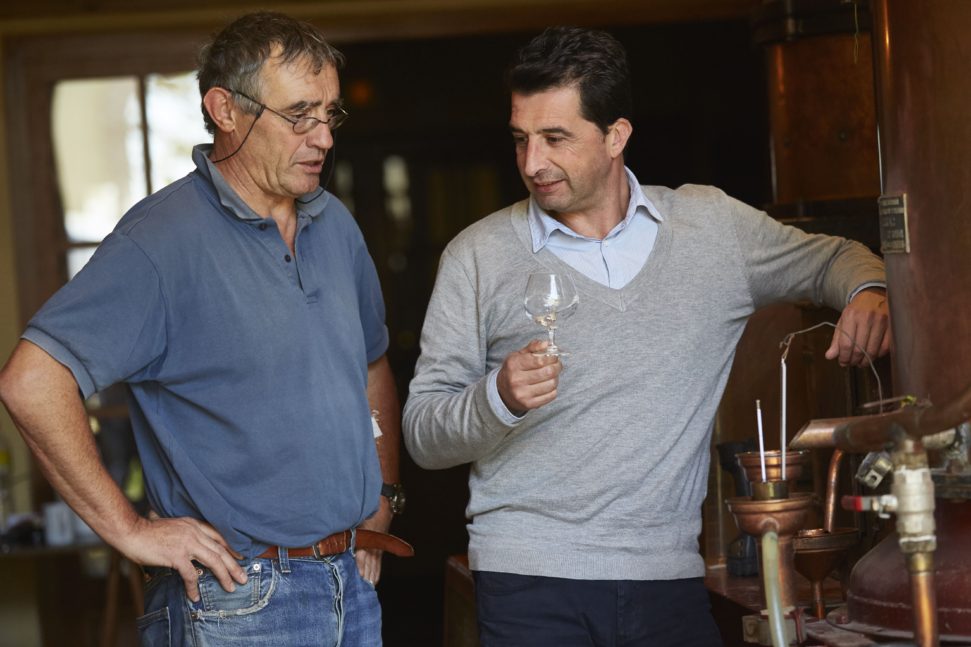
Today, the small firm of Darroze is the reference point for Armagnac. The reason for this stems directly from the original relationships Francis cultivated among his producers, and from the meticulous attention to detail Francis and Marc have brought to bear.
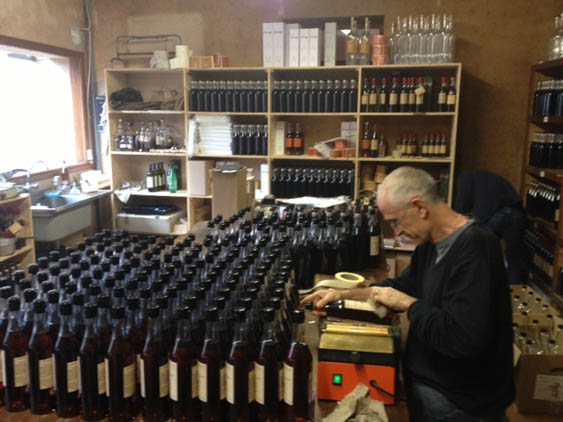
Mark continues to buy barrels of aged Armagnac from farmers just like his father did. He also buys the just distilled white spirits from a given farm and ages it himself. Some producers use their own stills; for others Marc employs mobile stills – both his own and those of professional distillers –to distill the wine beginning in November because distilling soon after fermentation ensures the highest quality of Armagnac. The goal is to finish all distillation before Christmas. Typically then a new spirit will go into a new barrel in the drier Darroze cellar (Marc has separate ageing cellars), two conditions that encourage faster evaporation and oxidation. After several years, this spirit is racked into an older barrel and moved to the more humid cellar, factors that naturally slow the maturation process.
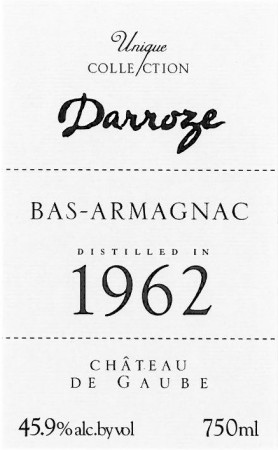
Darroze produces three lines of Armagnacs. The first is the range of blends, known as Les Grands Assemblages. The second is the Collection Unique, or single estate, vintage dated spirits. The third line, new as of 2019, is Luxe Gascon, an extremely limited range of very old, vintage Armagnacs from the first half of the 20th century. All come from farms in the Bas Armagnac, the westernmost district of Armagnac down low on the edge of the Landes forest where the soil was once swamp and before that beach—it’s very sandy. This translates into naturally low yields and higher acid grapes, which are perfect for distillation and give this district its reputation as the best in the region. To the east is the Tenarèze district with more clay and limestone, and further east is the Haut Armagnac zone, where the production of Côtes de Gascogne is centered.
Click here to see a video about the artisanal approach of Darroze. Here are Presentation Files: Darroze pres_final version. And here is a recent brochure.
The Eaux de Vie
| Eaux de Vie | Blend | Description |
|---|---|---|
| Les Grands Assemblages | 100% Armagnac | Until recently, Darroze made only one blended Armagnac: Réserve Spéciale. Today’s Grands Assemblages replace that (the 12-year is the corresponding blend) with seven blends, ranging from 8 years to 60 years. Four additions are permitted in Armagnac: coloring agents such as caramel; wood tannin; sugar; and water. Darroze uses only one of these—water—and only that to dilute the Armagnac in the younger blends to its required 43% ABV. After a certain age, natural evaporation or the "angels' share" naturally reduces the level of alcohol, meaning that the 50 and 60-year-old Armagnacs are so old that dilution is not necessary. For the 30 and 40-year-olds blends, it's a case by case basis; for the younger blends, it's a given. Speaking of the 8-year and 12-year, these are 100% Ugni Blanc. The 20-year is a blend of Ugni Blanc and Baco. As the blends get older from here, there is more Baco at each step. Ugni Blanc does not require long aging, whereas Baco's rough edges do, and with long aging Baco gains superb complexity. With all of these blends in this range, the age on the bottle is the minimum age of the youngest spirit of the overall blend. |
| La Collection Unique | 100% Armagnac | This was the original basis for the business: single vintage, cask-strength, single domain Armagnacs bottled to order. No additives are used for the Collection series, and none of these Armagnacs are ever blended. Each is marked with the month and year of bottling so that the buyer knows exactly how long the spirit rested in barrel (once bottled, the ageing process stops). |