Château Unang, Ventoux
| Country & Region | France, Rhône Valley |
| Appellation(s) | Ventoux |
| Producer | James and Joanna King |
| Founded | An exceedingly long time ago. In recent history, purchased by James and Joanna King in 2001. |
| Website | www.chateauunang.com |
My favorite producer in the Ventoux.
—John Gilman, View from the Cellar, October 2025
In 867, the Bishop of Venasque was given Château Unang, then known as Villa Unango. Nestled amid woodland on the flank of a hill high above a gorge, it faced east, basking in the rising sun until the sun began its descent over the hilltop to set in the west. The estate was almost certainly already old in 867. It may well have once been a Roman villa, for the Romans were in the neighboring village of Methamis. One could speculate further and suggest that if it were once a Roman villa, then it may have been built upon a former Greek villa—for the Greeks first came to the Rhone Valley in the mid 7th century BC and Unango, a most unFrench word, bears an interesting resemblance to the ancient Greek word for…wine vessel.
The bishop was given the estate because the nearby village of Venasque was the capital of the Comtat Venaissin until 1320, when the seat of government moved to Carpentras. The Venaissin state (comtat) was an independent enclave within France that came to house the Roman Curia and eventually gave rise to the Wine of the Pope, i.e., Châteauneuf-du-Pape. For over 800 years Unang was passed down from one bishop to another, until it was sold at the end of the 17th century (while Papal control of the Comtat continued until 1791, when France absorbed the enclave following the Revolution). Presumably, since the 9th century, a cross has stood on top of Unang’s hill.
In the late 18th century, an Italian aristocrat married into the family that owned Unang. Subsequently, the château was spruced up with a facelift, and a formal garden was designed to step down the hillside, following the path of a natural spring. Three terraced gardens were planted, each anchored by a fountain fed from the spring. In 1882 a six-meter wooden cross was mounted on a stone plinth on the hilltop, a restoration of an earlier cross. Frustratingly, the original date of the cross and other inscriptions in the stone have weathered away; much of that history, along with the origins of the name Unang, has been lost.
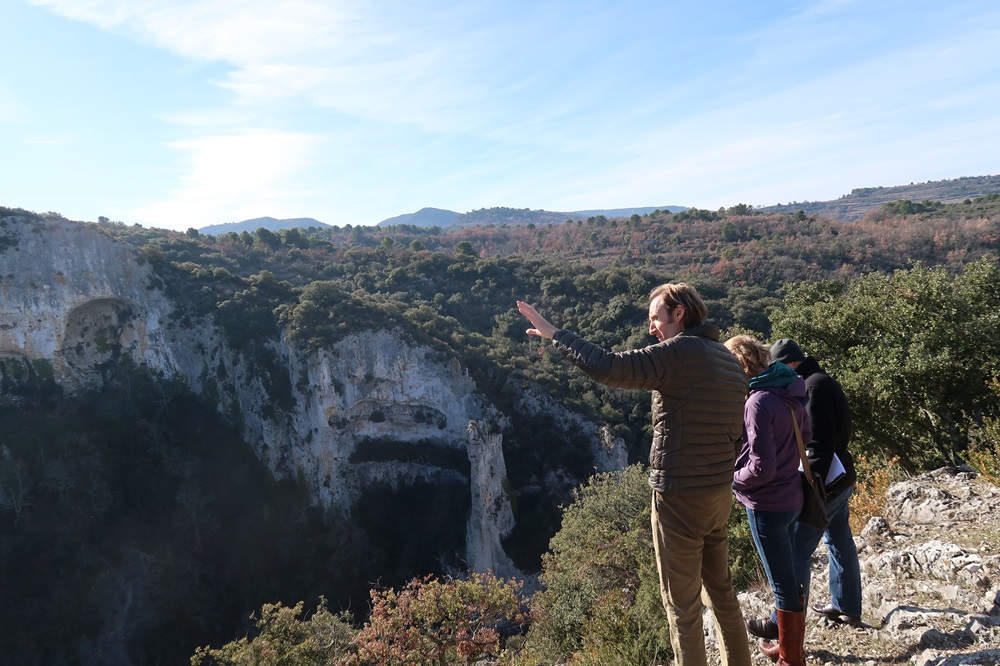
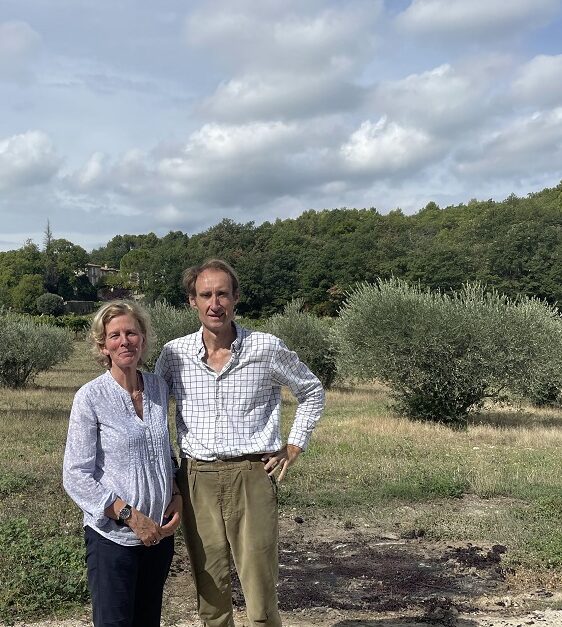
The property sits on its hillside deep in the tail end of the Nesque Valley, named after the Nesque River that flows out of the high Vaucluse Plateau to the east and runs through a rugged limestone gorge (that’s James above pointing out a feature of the gorge; behind him, out of sight and behind thirty-odd yards of forest, begin his vines). This is part and parcel of the true Ventoux appellation, which purists define as that half moon of hills that wrap around the plain of Carpentras from the north to the south to form an amphitheater facing west. Unang and the Nesque is at the southern end of this arc, and south of it the appellation legally continues to slope down to the Luberon Valley. Had they the power, Ventoux’s cognoscenti would strike the plain of Carpentras and the slope going down to the Luberon from the appellation in a heartbeat.
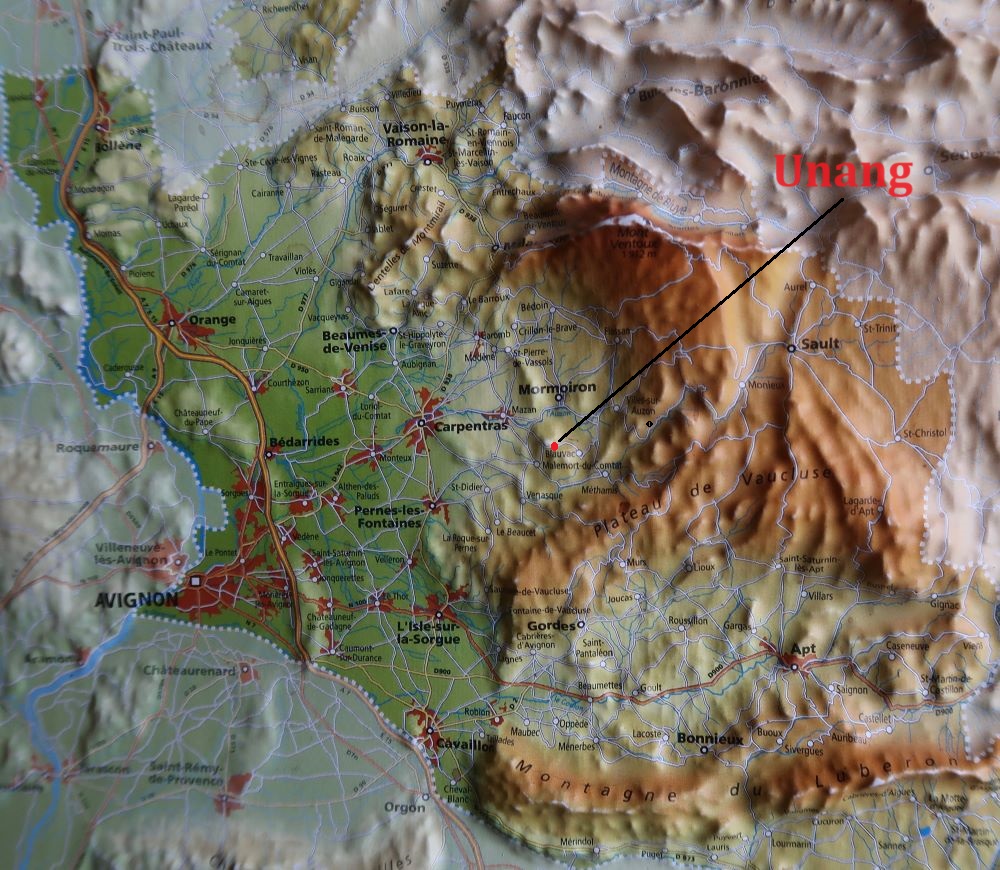
The domaine is isolated and self-contained with, interestingly enough, its own geological category: les sables d’Unang. This refers to a particular type of sandy soil that lies overtop limestone. Apart from Unang’s hillside, pockets of the sands of Unang are also found in the Gigondas AOC.
Unang’s vineyards all grow on site, mostly facing east with some to the south between 220 and 320 meters above sea level. Significantly, all are surrounded by forest, promoting biodiversity, enabling James to work organically without worry about neighbors who farm conventionally, and promoting cooler temperatures. It’s cooler here than many other parts of the Ventoux appellation, and certainly cooler than the Rhône Valley floor to the west. The Giant of Provence, Mount Ventoux, stands guard to the north, its bald dome of white limestone lending it all the gravitas a guardian needs. In 1990, UNESCO recognized the mountain as a World Heritage Site.
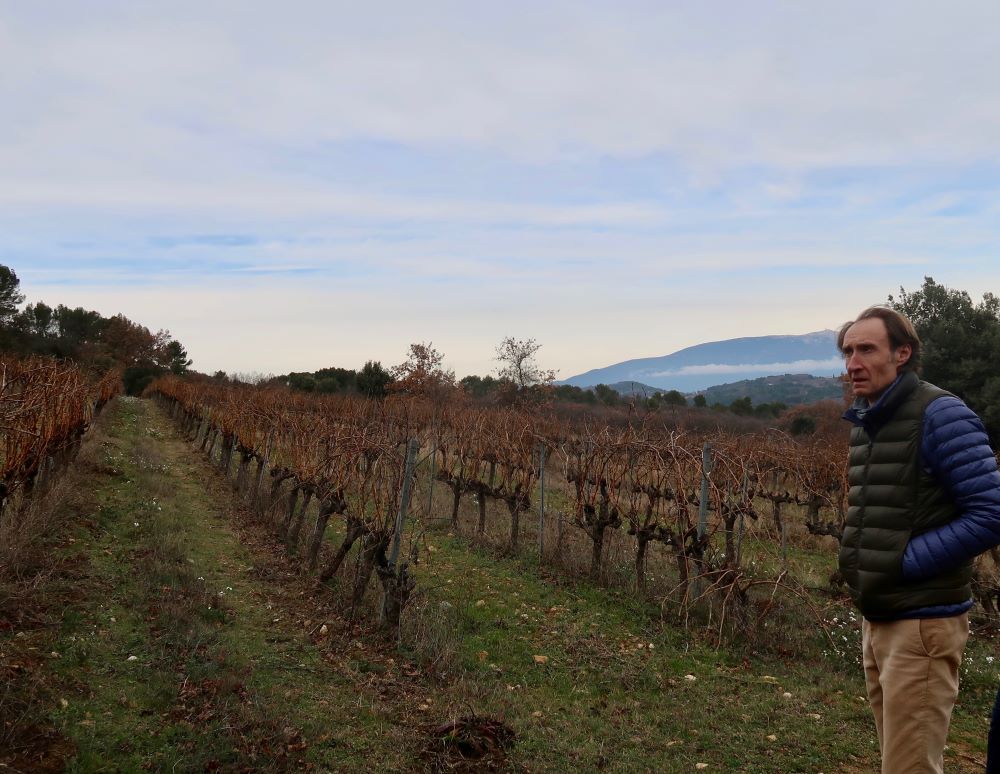
When James and Joanna King bought Unang in 2001, there were twenty hectares (49 acres) of vines in various parcels up and down the hillside, and in varying degrees of health. Six hectares (15 acres) of poorly sited and/or diseased vines were torn out, and a new cellar was put in. In 2003, James slowly began to replant, and he plans to grow to eighteen hectares of vines, or a little more than forty-four acres. The white varieties grow farthest down the hillside in the coolest zone, while the reds occupy the mid and upper slopes. What James likes in wine is elegance and depth, and his site enables him to make such wines par excellence. These are high-altitude, limestone wines of superb freshness, vigor, and minerality.
Harvesting under the Kings has been by hand from the beginning. In 2006, all use of pesticides and herbicides were discarded, and in the years that followed the domaine received organic certification in Europe from Ecocert (note that Unang is not certified in America by the USDA). Beginning in 2023, James began implementing biodynamic treatments, something he’d been thinking about for a number of years. Initially, he’s starting with the two classics: horn compost to aid root health and promote depth, and quartz to aid photosynthesis. He’s also considering tisane treatments such as chamomile and willow (chamomile seems to help with the stress of drought, and willow has shown promise as a preventative against downey and powdery mildew).
In recent years as well, James has been phasing out his use of small barrels (at the start of 2024, he was down to his last five 228L barrels) in favor of 600L demi-muids (eleven in 2024), plus he’s experimenting with amphore.
Watch a drone video of Chateau Unang.
The Wines
| Wine | Blend | Description |
|---|---|---|
| Ventoux rosé | Cinsault (roughly 40%), Grenache (30%+/-) and Syrah (30%+/-) | A classically dry and elegant rosé via direct press (ie, not saignée method), and one with welcome freshness from its high-elevation origins. Unfortunately, the domain only makes about 5,000 bottles in a given year, so get this while you can! |
| Vin de France Cinsault | Cinsault | From a 1.5 acre parcel James planted in 2005 at mid-slope, east facing, in sandy soils over limestone bedrock. A long, gentle maceration in steel, followed by élevage in steel. Production averages 1,500 bottles or 125 cases. Tech sheet here. Notes from the field: Punchy, Gamay du sud nose, with ripe, brambly berries. Round, juicy attack and cool, refreshing midpalate feel. Cherries and spice cake. Backend is delicate with a saline, mouthwatering mineral kiss that makes it so much more than just a gulper. What a cool tension between frontend juice and backend lift! |
| Ventoux rouge | Based roughly on 60% Grenache, then 30% Syrah, and the rest Cinsault | This is wine from the broad ring of hills wrapping a half-moon around the plain of Carpentras, i.e., the true Ventoux. Unang’s is a wine of terrific character at a refreshing price. This is clearly a wine of calcareous, high elevation soils, one with real elegance and breed. All raised in tank so this is pure fruit; production averages 2,500 cases. Tech sheet here. |
| Ventoux "La Source" | Roughly 70% Syrah, 25% Grenache, and 5% Cinsault | La Source refers to the natural spring that comes out of Unang's hill top--literally channeled through the house itself and no doubt used as the household water supply for ages--and which is so loaded with calcium that James has to yearly take a hammer to the deposit buildup coming out of the fountain in front of the house. This is the Syrah cuvée and comes from vines growing at 300 meters in the domain's most clay-rich soils, and is surrounded by oak and pine forests. Just over half the wine is raised in older barrels for one year. Production averages 850 cases. Tech sheet here. |
| Ventoux "La Croix" | Blend is similar to the classique above, but with less Grenache and more Syrah | The flagship of the domain, made only in the best years from a vineyard selection of less than five acres. These are the highest plantings, just under the summit of the hill, where the topsoil can be a mere eight inches deep before hitting limestone bedrock. The wine is deep and long, with a marked overlay of stone in the aromatics, and impressively elegant for its weight and structure. Around 80% is aged in demi-muids, 20% or so of which are new. Production averages 600 cases. |