Tenuta dell’Ugolino, Verdicchio dei Castelli di Jesi
California and Washington DC regional sales only
| Country & Region | Italy, Marche |
| Appellation(s) | Verdicchio dei Castelli di Jesi |
| Producer | The Petrini family: Andrea, Gabriele and Matteo |
| Founded | 1983 |
| Website | www.tenutaugolino.it |
Throw the raciness of Riesling, the breadth of Chenin, and the seriousness of Chablis across a blank canvas and swirl – you’ll get Verdicchio: salty, powerful, intense, wire-cutter acidity, bitter almonds, cool citrus, and above all, the capacity to age into something quite extraordinary.
–Tamlyn Currin, jancisrobinson.com, May 2018
Marche produces one of Italy’s greatest white wines in the form of Verdicchio.
–Eric Guido, Vinous, May 2024
Despite those ringing endorsements, the vast majority of the world thinks of Verdicchio as one more faceless Italian white wine in an endless stream of them, and most people think of it as cheap—therefore making it, if the folks up top know what they’re talking about, a genuine bargain.
They do, and it is. The problem (or the advantage, for those of us in the know) with Verdicchio’s image lies in the Marche’s post-war viticulture, which was dominated by a handful of very large producers and cooperatives whose power reigns to this day. Marche’s largest appellation for Verdicchio is Castelli di Jesi, and close to 60% of its production is controlled by cooperatives while most of the remaining 40% is bottled by négociants. Independent artisan producers are a precious few indeed.
One of them is Tenuta dell’Ugolino. This is a domain created in 1983 by Costantino Petrini, following his retirement. He bought a farm as a base for his family and a place to grow fruit, vegetables and wine grapes. His father, Ugolino, had been a farmer and the move represented a return to Costantino’s roots after a corporate life abroad, hence the name: Estate of Ugolino.
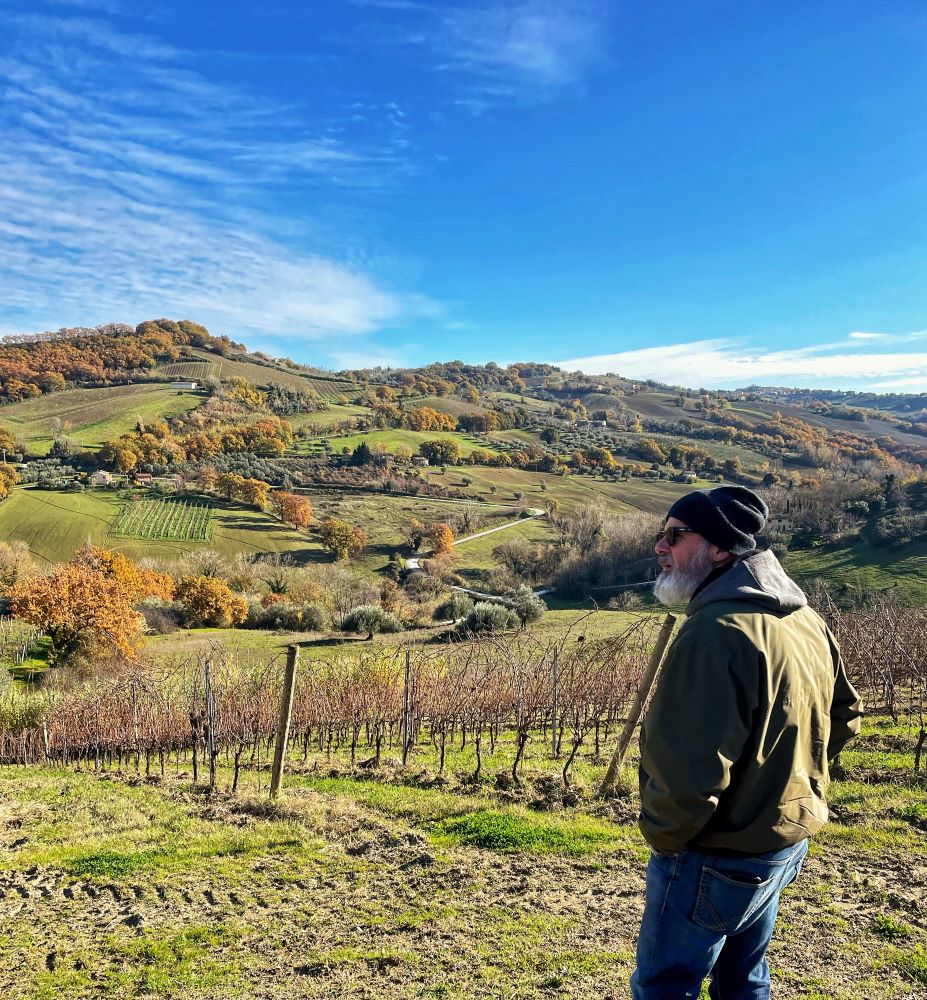
Costantino’s son, Andrea (pictured below at the Cupramontana vineyard), took over in the next decade, and began focusing on the vines. The estate is in the heart of the historic classico zone of the Castelli di Jesi appellation, an ancient seabed that runs from the Apennine mountains down through east-west oriented ridges and valleys to the Adriatic Sea. The limestone-rich appellation gives Mediterranean warmth coupled with diurnal swings from the Apennines—all of which, combined with the ever-present oceanic breezes funneling through the valleys, makes for ideal conditions for wine grapes. Andrea well understood this. He trained in agronomy and winemaking, and for a number of years worked at other wineries while preparing the ground at Ugolino.
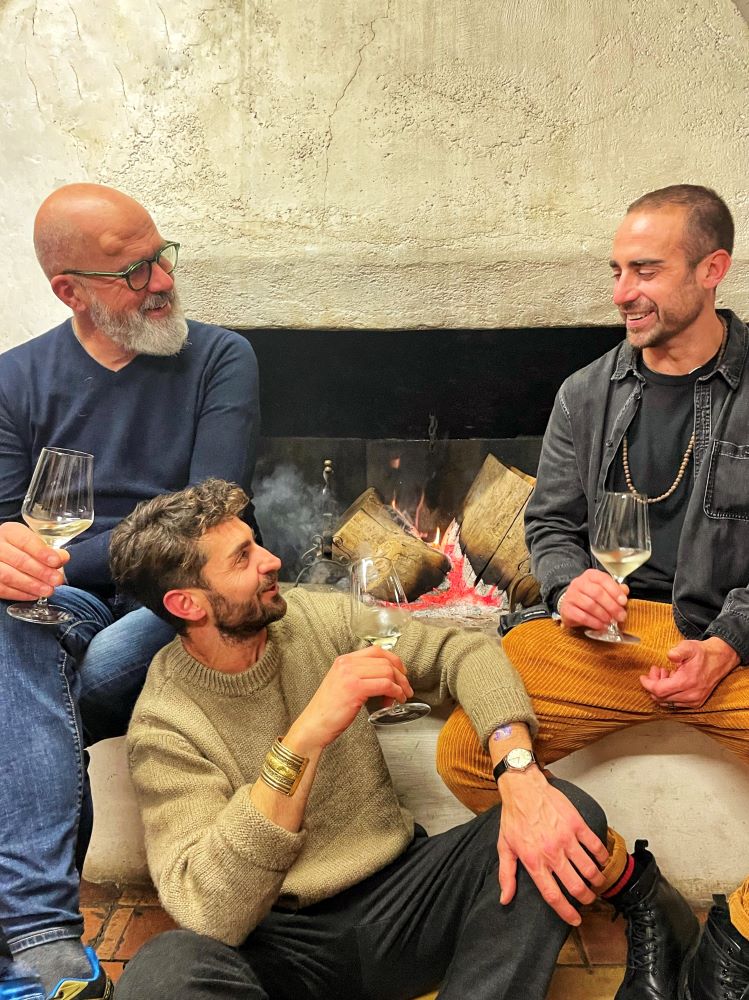
He began with his father’s original 0.7 hectares of vines, or 1.7 acres. The initial harvests were sold to Fazi Battaglia, one of the post-war négociants with large holdings. Andrea bottled his first wine in 1993, and over the decades carefully increased the vineyard surface to 14 hectares (35 acres). In 2015, his stepson Matteo joined him and together they made the transition to organic viticulture, earning certification in 2020.* In 2021 his other stepson, Gabriele, joined the duo, and in the same year the Slow Wine Guide awarded the estate “top wine” for the Verdicchio from its Balluccio cru. Pictured below are Andrea and his stepsons Gabriele (center) and Matteo.
These days, the estate’s Verdicchio vines are spread across three communes in the hills of the Catelli di Jesi appellation:
• 8 hectares (20 acres) at the estate in Castelplanio, of which 1.5 hectares make up the single-vineyard of Balluccio. The vines face south-southwest at an elevation of 660 feet. The soil is sedimentary limestone, in this case siliceous with marls and clay.
• 4 hectares (10 acres) in the San Michele vineyard in Cupramontana. This lies across the Esino Valley south of the estate in one of the highest zones of the appellation—1,650 feet of elevation. Exposure is to the southwest and the soils are rich with calcareous clays.
• 2 hectares (5 acres) in Montecarotto, due north of the estate at 820 feet of elevation. The vines face west and the soils are calcareous clays.
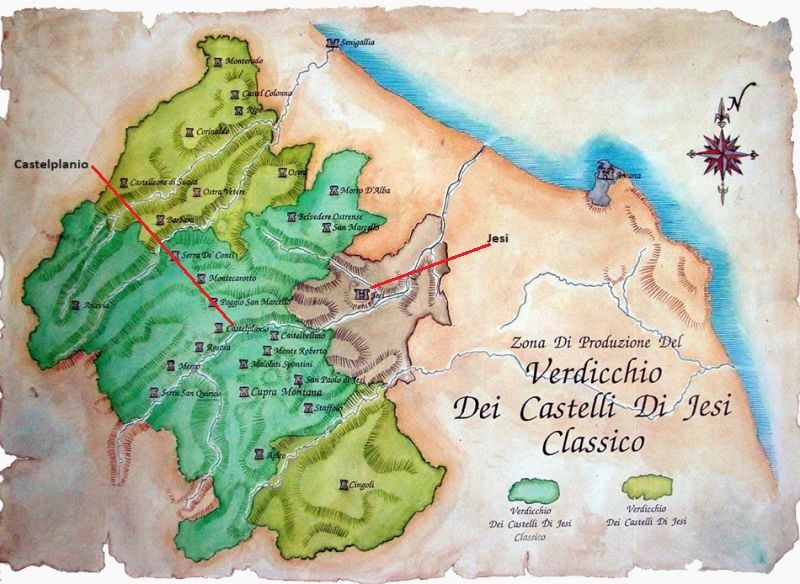
Marche has two appellations for Verdicchio, a grape that has grown here since at least the Renaissance. It’s thought to have migrated down from the Veneto during plague times, and DNA testing shows it to be the same as Trebbiano di Soave (Verdicchio the wine owes its distinct identity to Marche’s hills and their limestone clay soils). The two DOCs are Verdicchio dei Castelli di Jesi, sloping down to the Adriatic; and Verdicchio di Matelica, up in the mountains. Of the two, Castelli di Jesi is responsible for roughly 80% of Marche’s Verdicchio.
As for the name Castelli di Jesi, it translates as the castles of Jesi, referring to the castles, i.e., the small wine villages, that occupy the heights behind the medieval market town of Jesi, east of Tenuta dell’Ugolino and closer to the Adriatic. The Marche is dotted with ancient fortifications from the time when it was something of a no man’s land (apparently the term Marche is a Germanic derivative for borderland). Later, like its neighbor Romagna to the north, it became a remote Papal state. The region covers a swath of the Adriatic coast and hinterland behind the knee of the Italian boot.
*Note that while the estate is certified in Italy by Valoritalia, it is not certified in America by the USDA.
The Wines
| Wine | Blend | Description |
|---|---|---|
| Maltempo | Verdicchio | Maltempo is Ugolino's sparkling Verdicchio, named after a little river that runs by the vines in Castelplanio. The name translates as bad weather, but it had a positive connotation because there was once a mill on this watershed, and if the watershed got a little angry and agitated, that meant more power for the mill! The wine is made in tank via the Charmat method, whereby the secondary fermentation takes place in tank and the natural CO2 is captured in the wine. The grapes come from 3 hectares or 7.5 acres in Castelplanio averaging 15 years of age, and are harvested in stages by hand. Production averages 900 cases annually. Tech sheet here. |
| Le Piaole | Verdicchio | Le Piaole (le-pi-olay) is the mainstay of the estate, coming from all three vineyards. Ferments typically are about half spontaneous and half started with neutral yeast. Aging is in stainless steel over winter and then in bottle for a minimum of two months prior to release. Production averages 6,000 cases. Tech sheet here. |
| Vigneto del Balluccio | Verdicchio | The estate’s cru, a 1.5 hectare or 3.7 acre parcel on the winery grounds in Castelplanio. Ferments are spontaneous, aging is in stainless steel over winter and into the summer, with a minimum of five months of bottle age prior to release. Maximum production is 800 cases. Tech sheet here. |