Domaine Serrigny, Savigny-lès-Beaune
| Country & Region | France, Burgundy |
| Appellation(s) | Savigny-les-Beaune |
| Producer | Marie-Laure Serrigny |
| Founded | late 19th century |
| Website | www.domaine-serrigny.fr |
She is clearly one of the top producers in her commune.
—John Gilman, View from the Cellar, December 2022
Domaine Serrigny is a family operation deep in the hollow of Savigny-lès-Beaune. The household is on the hill behind the local château, and when you pull out of their road you can look down and see the seigneur’s crazy collection of mothballed fighter jets. He’s got them lined up on the chateau’s lawn, an eclectic display of man’s bird of prey.
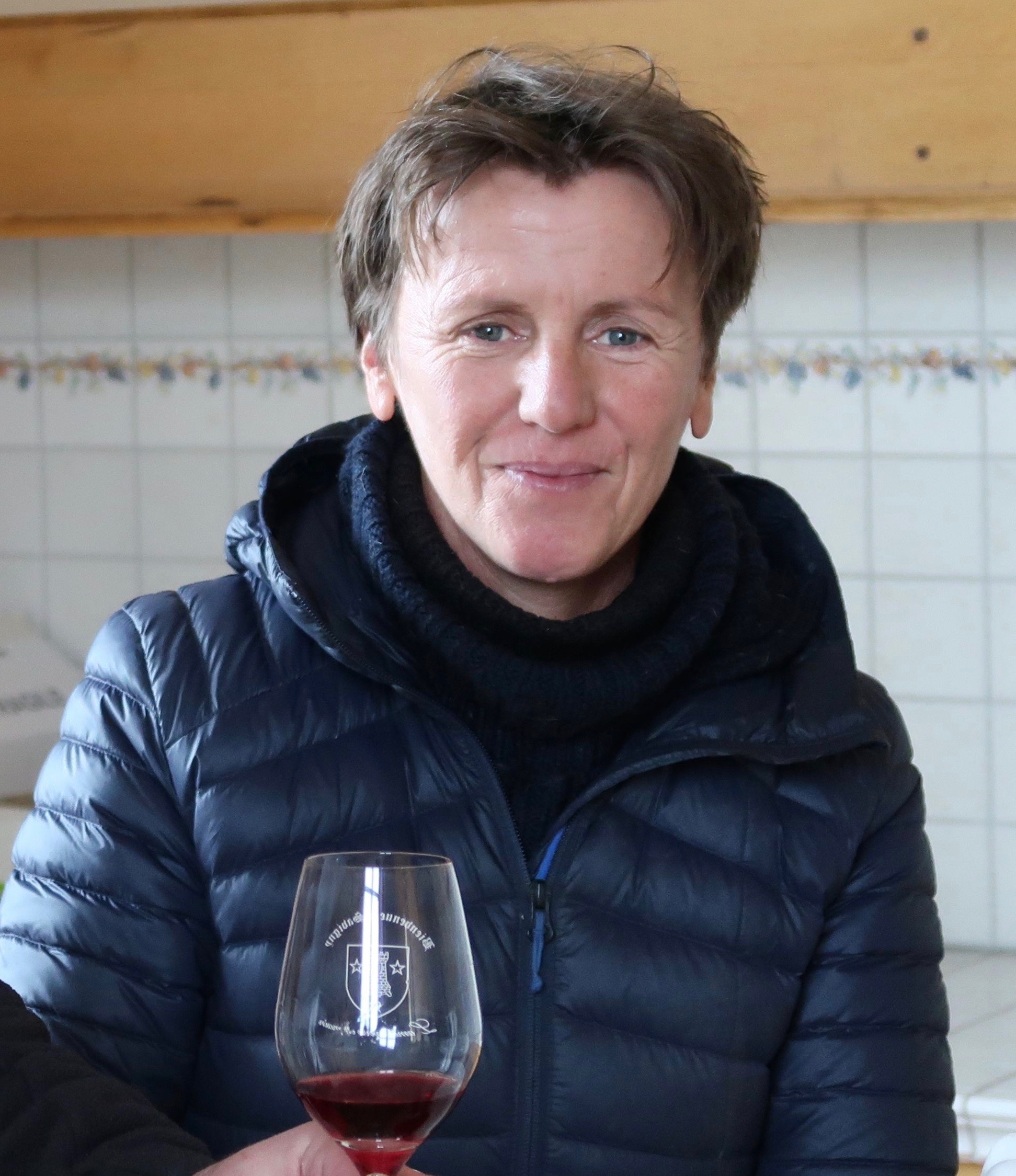
Domaine Serrigny dates to 1840, when Eugène Serrigny started the domaine in Savigny-lès-Beaune. Serrigny is the main village in the neighboring commune of Ladoix-Serrigny, and the speculation has long been that Serrigny was the name of a Roman settler during the Roman occupation of Gaul…so it’s within the realm of possibility that Eugène was a descendant. Be that as it may, today the domaine is made up of over seven hectares of vines (17+ acres) and is run by Marie-Laure Serrigny, the fourth generation after Eugène. At age 18, she joined her father at the domaine. Her younger sister Francine joined in 1995, after, like Marie-Laure, undergoing studies at the Beaune winemaking school. That same year, their father died unexpectedly, leaving the two daughters in charge. At the time, they were 23 and 25, and as a team they went on in the years to come to tend the vines, make the wine, and do all of the myriad of things involved in running a domaine until late in 2016 when Francine succumbed to a battle with cancer.
Gilles Mathieu, a former member of Jean-Pierre’s team over at Domaine Joseph Voillot, grew up in Savigny and had known the Serrignys all his life. He pretty much insisted that I visit, which I did early in February of 2016 without high expectations. The appellation is dominated by a handful of players and there was no press to speak of on the Serrigny wines.
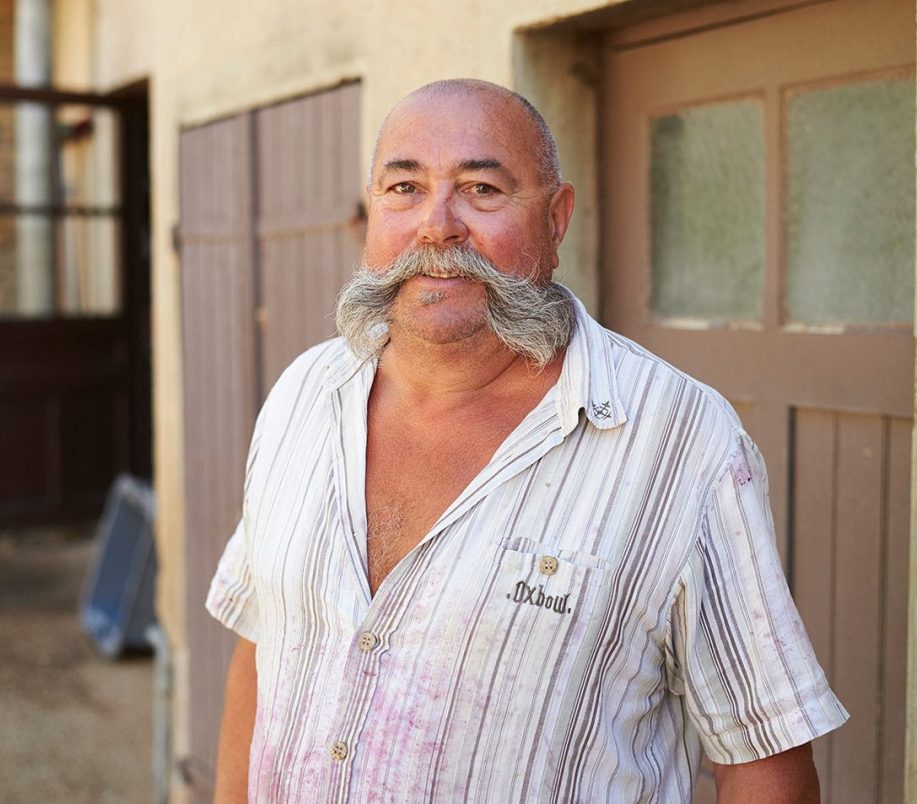
Francine met me in her little courtyard on a wet afternoon. She wore boots, jeans, an old fleece over a sweater, and she had a tired air of savoir faire without any pretense whatsoever. Marie Laure, dressed much the same, made an appearance to say hello and left for more pressing matters. The office Francine took me to had the look of a room that had been well used a generation ago. A fax machine still sat in the corner, plugged in. She opened a 2014 Bourgogne Blanc, and from the first scent of orchard fruits and minerals and honey I was carried away. Gilles arrived as the second wine got opened, his bald pate gleaming from the rain and his magnificent, sweptback moustache flaring like wings from his cheeks. As night fell, Jean-Luc Rousseau came in from the vines (at the time, he was Serrigny’s cellar master). A reputed soccer goalie in his youth, he was an enormous man with a great spread of arms, and he came into the dark room cold, wet, tired, and grateful for a glass. We sat around an old oak table in that modest office tasting what was an eye-opening range of old-vine wines from two vintages as the three friends caught up and warmly exchanged opinions on the wines. Among French growers, this was a common occurrence. For an American, it was a privilege. And not everything in Burgundy had been discovered, that was clear that evening. It was still possible to stumble upon two hardworking sisters who maintained a fax machine, did pigeage by foot, and made killer wines.
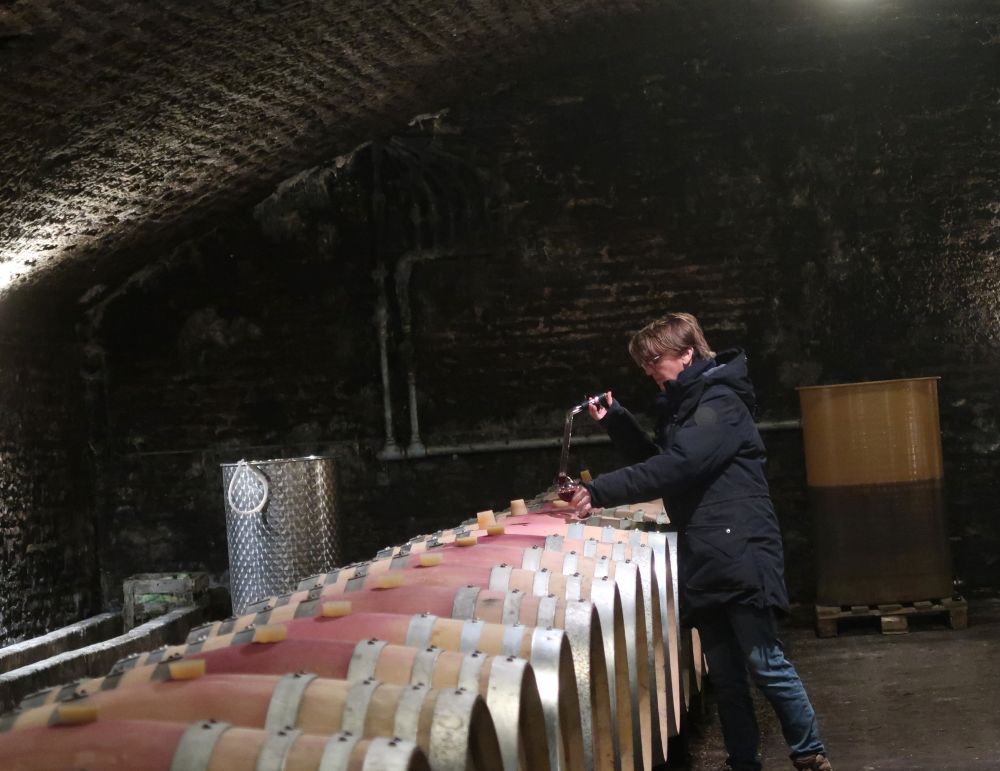
Domaine Serrigny farms small parcels in Auxey-Duresses, Côte de Nuits-Villages, Corton Charlemagne, Meursault, Monthelie, and Pernand Vergelesses, but the historic heart of the holdings are in Savigny. The farming culture is lutte raisonnée, i.e., sustainable, and the approach in the cellar is quite traditional. The parcel and the maturity dictate de-stemming entirely or partially or not at all (old man Serrigny apparently never de-stemmed); ferments are spontaneous and the reds undergo alcoholic fermentation in wooden uprights; the cap is still, remarkably, broken up by foot; and all of the élevages take place in older barrels for fourteen months (sometimes less for the whites, sometimes more for the reds) before racking to steel where the wine rests for several more months. No fining for the reds, and bottling with only a light filtration.
Another salient fact is that Marie Laure works with some very old vines. These perforce give low yields, and it’s an exceptional vintage here that gives as much as 40 hectoliters per hectare. She’s not afraid to wait for good ripeness either. The result is a range of Pinots deliciously rich with earth, fruit and spice, and frequently, depending on how limey the limestone soil is in a given plot, quite mineral. They also have excellent acidities and tannic structures. Her Chardonnays are plump, toothsome renditions underpinned with driving acidity. These are wines made with a modest yet sure hand, which in all things wine is the most honest of hands. Average production is 2,500 cases.
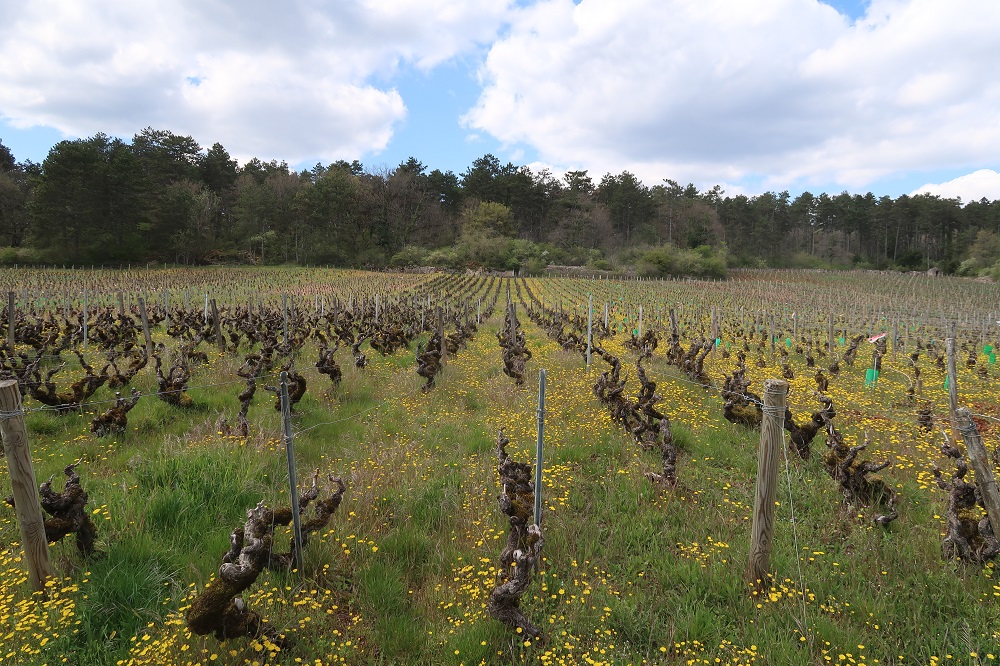
Above is her Les Perrières parcel of Aligoté, all 12 rows, on the plateau above Savigny. These may be the oldest vines in the village.
Photo of Gilles Mathieu courtesy of Sébastien Erôme.
The Wines
| Wine | Blend | Description |
|---|---|---|
| Bourgogne Aligoté | Aligoté | From two parcels planted during the restoration of Burgundy's viticulture following the phylloxera devastation. One parcel, Les Perrières, is on the plateau behind the village and its vines are centenarian; the other parcel is Commeys in Ladoix-Serrigny and its vines are over 80 years old. Raised in older barrels. A wine with old vine intensity and drive. 200 cases. Tech sheet here |
| Bourgogne Blanc | Chardonnay | Mostly this comes from the northeast corner of Meursault: an acre of mature vines planted in Herbeux (a site whose pedigree is such that it never, as Marie-Laure points out, need blush in the presence of a Meursault villages) and another acre spread between Les Malpoiriers and Lombois. The grapes from these sites are augmented by grapes from a third of an acre planted in 1993 in Savigny-lès-Beaune's Les Perrières, a very rocky, calcareous vineyard that is one of the highest in that commune. The wine is raised in neutral oak for twelve months, then racked into steel for another four months. The fruit and tension in this wine is remarkable every year. For Bourgogne Blanc, it's a great buy. Production averages 400 cases. Tech sheet here |
| Bourgogne Rouge | Pinot Noir | From three parcels in Savigny: Les Chevrières, a high, rocky site planted to a third of an acre in 1980; Les Préveaux on the plain near Savigny's watershed planted to just over a half acre in 1960; and Les Boutières on the Aloxe-Corton border planted to a half acre in 1995. Serrigny's Bourgogne Rouge is aged 12 months in neutral barrels and then six in large steel blending tanks. Production averages 400 cases. Tech sheet here |
| Savigny-lès-Beaune blanc | Chardonnay | Three parcels produce this wine: Les Connardises, Les Bas Liards, and Les Pimentiers, planted in 2010, 1989, and 2008 respectively and totaling just over an acre and a half. Elevage is the same as for the Bourgogne Blanc. Production averages 375 cases. Tech sheet here. |
| Savigny-lès-Beaune rouge | Pinot Noir | Marie-Laure’s Savigny rouge comes from less than three acres spread among the parcels of Aux Champs Chardons, Aux Fourches, and Les Planchots. Production averages 500 cases. Tech sheet here. |
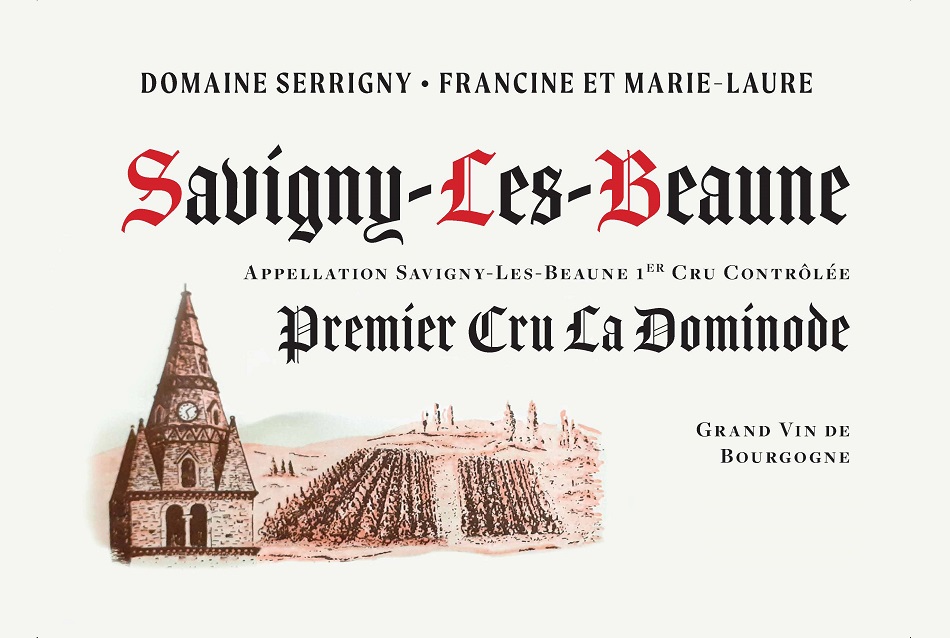
| Savigny-lès-Beaune 1er cru La Dominode | Pinot Noir | Serrigny’s 1.3 acres of vines in Dominode, a subzone of the premier cru Jarrons, are now about 100 years old and grow adjacent to those of Bruno Clair. In riper years, about half the grapes are de-stemmed before fermentation. The soils here are sandy and make for a supple wine with exceptional finesse and length. The name probably comes from the Latin “Dominus,” owner, master, or lord, implying that back in the day this site belonged to the Lord of Savigny. In a good year, production averages 250 cases. Tech sheet here. |
| Savigny-lès-Beaune 1er cru Les Peuillets | Pinot Noir | The domaine has 0.54 acre of vines in Peuillets ("peu-yā", with a long 'ā') planted in 1965. Like the grapes from Dominode, in riper years only about half the grapes are de-stemmed prior to fermentation. The soil here is much more influenced by limestone and the wine is consequently more mineral and “lifted” in profile than the Dominode. In a good year, production averages 150 cases. Tech sheet here. |
| Auxey-Duresses 1er cru En Bas des Duresses | Pinot Noir | Serrigny's parcel amounts to two-thirds of an acre facing northwest, and it was planted in the 1960s. The domaine first made wine from these vines in 2016, when it bought the parcel from Domaine Moulin Landin. Alcoholic fermentation was done entirely without stems both in 2016 and 2017. Savigny's terroir favors a profile of black fruit; Auxey gives red fruit. Normal production is 150 cases. Tech sheet here |
| Meursault | Chardonnay | From three parcels: one just over half an acre in Les Clous Dessus, a site high on the slope southwest of Meursault with marly soil common to many of Meursault's premier crus (as well as in Corton-Charlemagne); and two parcels totaling half an acre in Moulin Landin, immediately to the southwest of the town that is quite calcareous. Wine from the two sites is raised separately for twelve months in barrels that have seen 1, 2, and 3 vintages, then assembled in steel for four months. Production averages 180 cases. Tech sheet here. |