Champagne Thierry Fournier, Festigny
| Country & Region | France, Champagne |
| Appellation(s) | Champagne |
| Producer | The Fournier family: Thierry, Murielle, Maxime and Julien |
| Founded | Their forefathers began making wine in the 1930s. |
| Website | champagne-thierry-fournier.com |
The Fournier family began making wine in the 1930s with the purchase of three-quarters of a hectare of vines. This was in Festigny, a small village on the left bank of the Marne in the secluded Flagot Valley, long celebrated as a cradle in Champagne for Pinot Meunier. That modest purchase was simply an addition to the various flora and fauna the Fourniers cultivated, but it did get them into production (most of which was sold to the négociants).
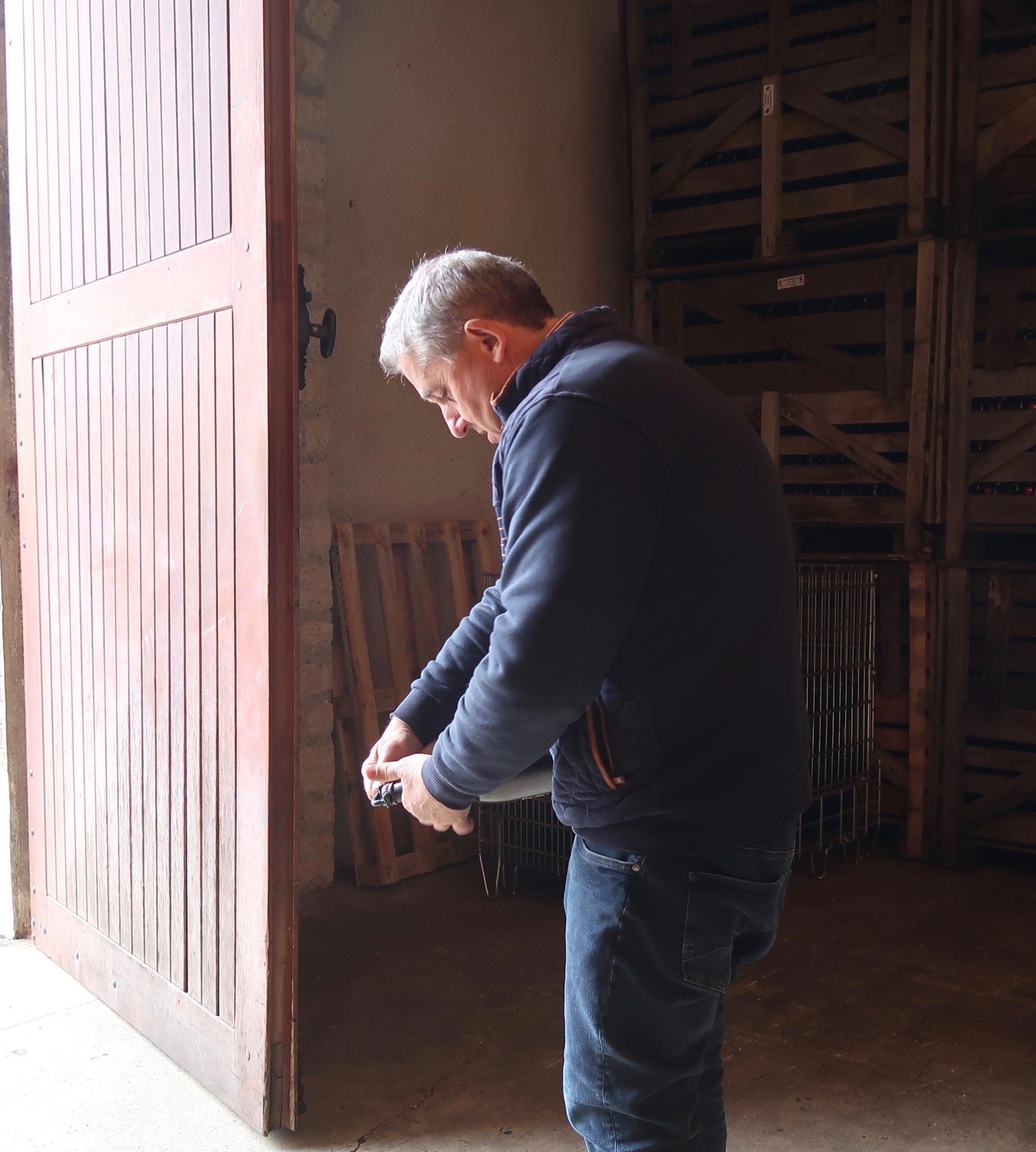
Little changed until Thierry (pictured below disgorging a bottle) joined his grandfather on the domaine in 1983. With Grandpa’s encouragement, Thierry began the Cuvée Réserve. Wasting no time, he also began to look for more vines, for he was a young man who wanted to make great Champagne from his own vines. In the years that followed, the Cuvée Réserve became the Fournier flagship and the vineyard surface grew from 1.9 to 15.40 hectares (38 acres).
Things reached a size whereby the little physical plant of the domaine, however spic and span and well buttoned down it might have been (and it was; Thierry is nothing if not organized), bulged at the cellar. Despite enlarging the vat room in 2007-08, Thierry and Murielle, his wife and active partner in the estate, found themselves with less and less room to operate. By that time in their lives, however, they may well have continued with the status quo had not both of their sons committed to joining the family domaine in one capacity or another. With that came the resolve to make one final gambit: the purchase, in 2018, of a long-shuttered cooperative winery in Cuis, built just after World War II with a plethora of space deep underground, the capacity to move wine by gravity, and the ideal storage for aging wine en tirage. In 2023, fully renovated, the facility opened its doors just in time to receive the harvest.
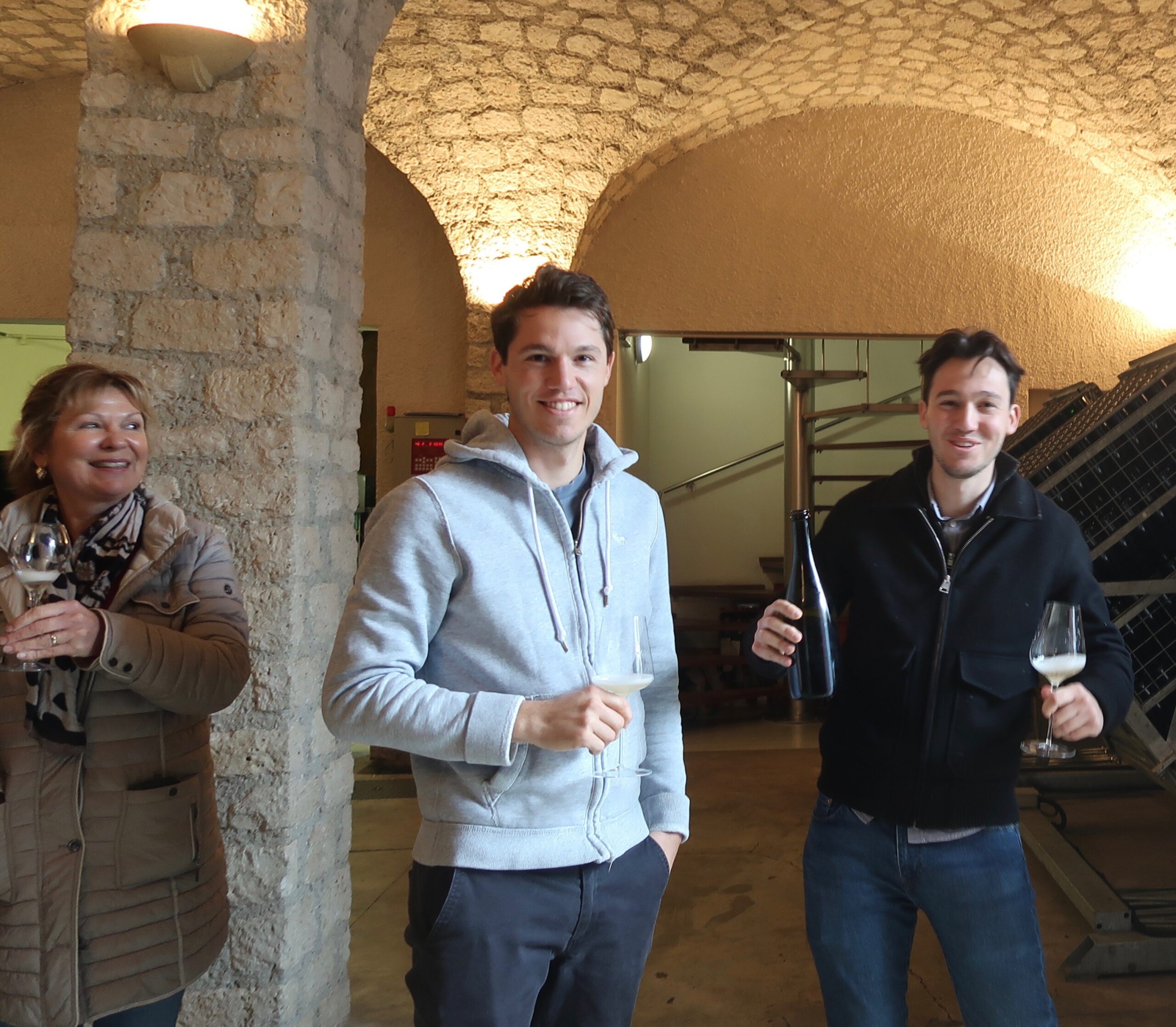
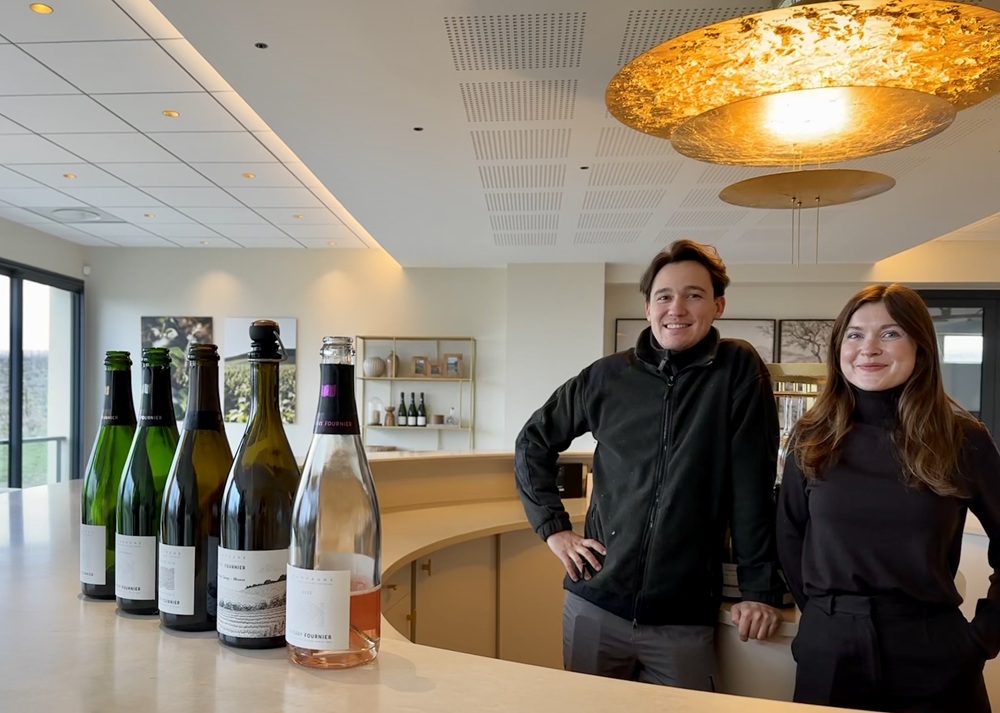
The sons are Maxime and Julien (pictured above with their mother Murielle). Julien joined the domaine full time in 2020 after completing his winemaking and viticulture studies. Maxime, the older brother, is on hand for major vineyard and cellar operations when he’s not flying long-haul routes as a pilot for Air France. These brothers are the 5th generation, and they work alongside their father Thierry. Thanks to them, Champagne Fournier made its first vintage in 2018. The two of them are also heading up essays in single site wines as well as with fermentations and élevage in barrel–the first, Les Grands Champs, was released in 2025 from the 2020 vintage.

Of the 15 hectares of vines, seven are in the family base of Festigny. This is in the small valley of Flagot, behind the first row of hills flanking the Marne to the south. The soils are chalkier than in the greater Marne Valley, which gives Meunier more precision and class than Meunier grown in the greater Marne’s clay-rich soils. Moreover, its amphitheater-like shape gives its vines exposure to the north, south and east. The dominating hill is La Côte des Châtaigniers, a great rectangular guardian of the valley around which the Flagot stream meanders on its way to the Marne. It’s flanked by vines and crowned by forest, very much in the likeness of the hill of Corton. (It was contested toward the end of WWI, when the Germans held it for a few days until driven out by the French, who held the opposite hill, and between these forces lay forlorn little Festigny.)
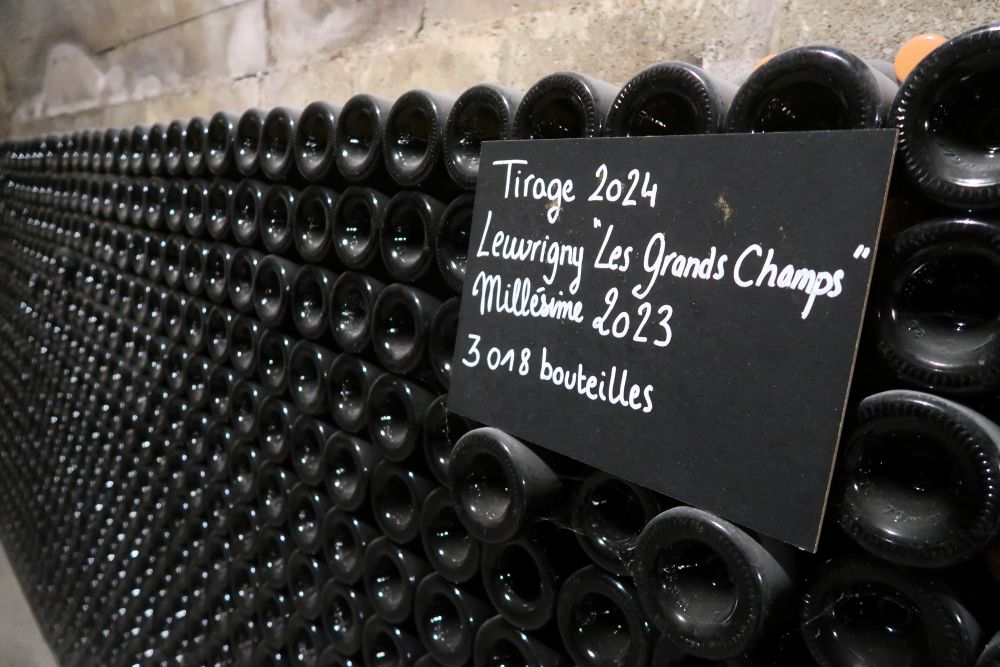
The Fournier’s 15 hectares of vines are divided into 50+ parcels across 13 villages, almost all in communes neighboring Festigny. The farming culture is lutte raisonnée, but the brothers have a keen interest in organics (about 4 hectares are currently farmed organically). Élevage under Thierry’s hand went until April following the harvest, and this is still the case for the Réserve, made at the family winery in Festigny; all of the other wines are now raised until July in the new space in Cuis and then put into bottle en tirage/sur latte to rest on the lees (like Les Grands Champs resting sur latte in the photo below).
By variety, the total vineyard breakdown is:
80% Meunier
10% Chardonnay
10% Pinot Noir
The vines average age is 45 years and production ranges from 70-90,000 bottles annually.
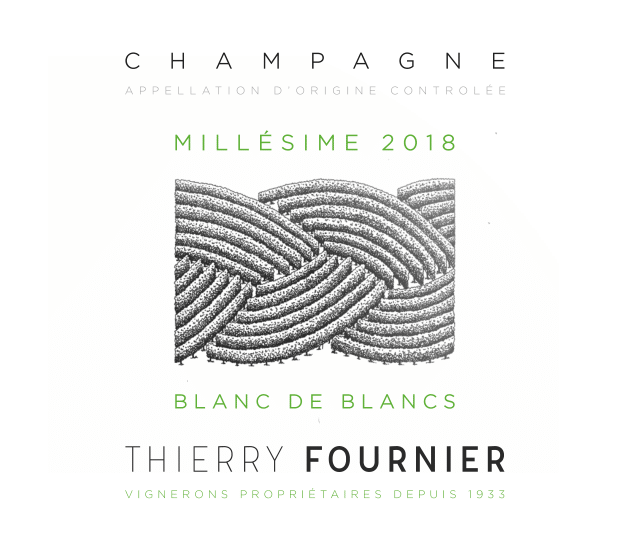
With the coming of Julien and Max came a new label and logo for the NV and blended site wines—one of a braid, symbolic of family ties, of movement and of topography.
Julien and his better half, Justine, in the newly renovated facility in Cuis.
The Wines
| Wine | Blend | Description |
|---|---|---|
| Réserve Extra Brut NV | 70-80% Meunier with Chardonnay and Pinot Noir | The Réserve is the domaine’s flagship, with a blend mirroring its vineyard makeup and representing half of its production. It’s blended with 40% reserve wine from a perpetual stock and rests on its lees in bottle for up to four years before disgorgement. Beautifully mature upon release, this is a full-bodied, chalky, and long Champagne. Julien and Maxime have been decreasing the amount of dosage from 5 g/l down to (with the 2023 base vintage) 3 g/l. Production averages 25,000 bottles. Tech sheet here. |
| Blanc de Blancs Extra Brut NV | Chardonnay | From parcels in Oeuilly in the Marne and Nesle-le-Reponds deep in the Flagot Valley. The clay soils in these communes are deeper than those found along the Côte des Blancs, making for a richer style of Chardonnay. This rests 18-24 months on its lees in bottle and is given 3 g/l of dosage at disgorgement. Tech sheet here. |
| Rosé Brut NV | Meunier | A 100% Meunier wine, including the 5% of still red wine from barrel. This is an intentionally short tirage of 15 months to emphasize freshness. Two-thirds of the blend is from their perpetual reserve stock. 4.5 g/l dosage and the lot number gives the base vintage. Tech sheet here. |
| Millésime 2018 | Chardonnay | This is the domaine’s first vintage wine, made at the wish of the new generation. From their best parcels of Chardonnay, most of which are in Festigny. Tech sheet here. |
| Les Grands Champs | Meunier | A blanc de noir Champagne from Meunier planted in 2002 in Les Grands Champs, a lieu-dit in the commune of Leuvrigny, just north of Festigny where the Fourniers have 0.88 of an acre of vines. Half of this was raised in neutral 228 and 350L Burgundian barrels and half in steel over winter and bottled en tirage in April, to rest on its lees for a minimum of three years before disgorgement. The first production from vintage 2020 saw 2,800 bottles. Dosage: 3g. |