Benjamin Serer, Vouvray

| Country & Region | France, Loire Valley |
| Appellation(s) | Vouvray |
| Producer | Benjamin Serer |
| Founded | 2019 |
Benjamin Serer is one of the most focused young growers in Vouvray…soft-spoken yet meticulous, Serer favors discipline over stylistic gesture, letting Chenin reveal itself without interference. His domaine offers a study in minimalism and intent–built not on scale but on attention–and it is already one of the more promising small addresses in Vouvray.
—Yohan Castaing, The Wine Advocate, September 2025
Benjamin Serer originally wanted to be a chef. He got as far up the ladder as opening a restaurant in Switzerland for the Alain Ducasse Group and then cooking at Ducasse’s Le Louis XV in Monaco for a year. The latter was an intensely competitive experience: when he wasn’t sleeping, he was in that kitchen, and at some point the joy just went out of it.
He returned to his native Tours in 2006 and opened a brasserie, which he managed until 2017. At lunch, he cooked; at dinner, he ran the front of the house as a wine bar (evenings, the kitchen simply served platters of charcuterie and cheese). He became more and more intrigued with wine, an interest encouraged by growers whom he had befriended, and eventually he enrolled in the wine school in Amboise. Key internships followed with Mathieu Cosme, Vincent Carême, and Philippe Foreau of Domaine du Clos Naudin.
In 2019 he took a leap of faith and rented 1.6 hectares of vines. These averaged 50-years of age and grew on what’s known as the première côte (the first south-facing hillside rising above the Loire) in the commune of Vouvray. He made one wine in that vintage, labeling it simply as Le Sec.
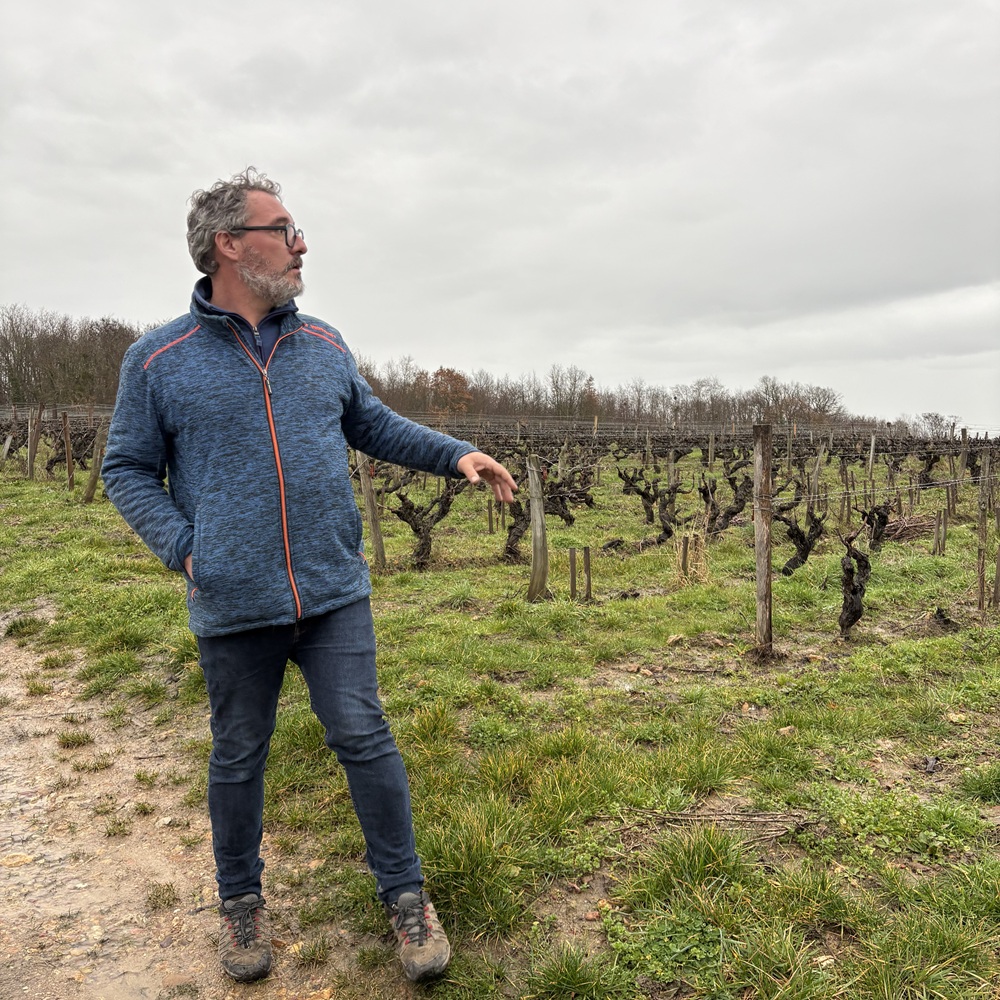
In the same year he took a job managing 18 hectares of vines on the plateau of Vernou-sur-Brenne for a friend who had just bought them from a retiring vigneron. The understanding was that Benjamin would come to know the vines while at the same time putting together finances in order to buy what most appealed. In November of 2022 he did just that, choosing several choice parcels—one a stone’s throw from Hüet’s famous Clos du Bourg parcel—totaling 5.4 hectares. The following year he quit the viticultural gig (his friend sold the remaining parcels to others) and went full time on his own domaine, which now came to 7 hectares or 17.29 acres in Vouvray and Vernou-sur-Brenne.

Right away he started farming organically and expects to be fully certified in 2026. In the cellar, he’s equally mindful. Prior to 2019, he had tried his hand at making natural wines with a number of varieties and came away agreeing with Friuli’s Josko Gravner that in minimal doses at the right time, SO2 was the sole addition needed during the winemaking process. For Benjamin, the right time is at bottling, when the wine leaves his care.
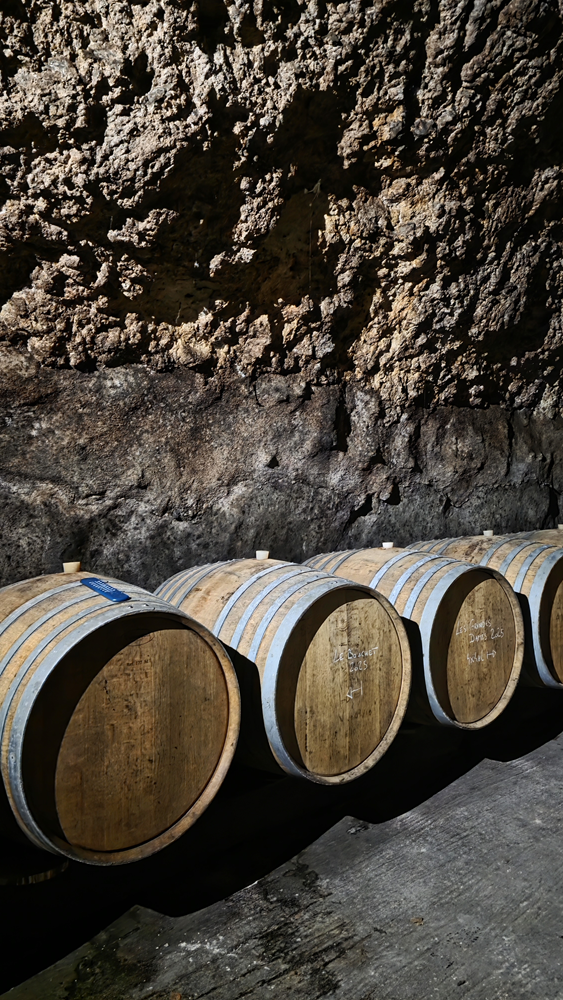
Until then, he doesn’t use SO2, particularly not at pressing—which is often done to secure healthy juice—because it dumbs down the wine. Consequently, even though he has a cool cellar burrowed into a hillside, he frequently sees malolactic fermentation starting with or soon after the start of his alcoholic ferments (all ferments are spontaneous). It’s important to understand that he doesn’t aim for ML, but neither does he stop it if it occurs. He has learned that if the malolactic fermentation happens early in the alcoholic transformation, then it adds a lot while taking away only a little (it’s when ML starts at the end, or after, alcoholic fermentation that it results in a perceived lack of acidity and a heaviness in Vouvray). To compensate, he often chooses to harvest on the early side and to let his alcoholic fermentations go for extended times to eat up all sugars. The result is a wine with good stability, enabling him to forgo filtration and to use only a touch of SO2 at the end.
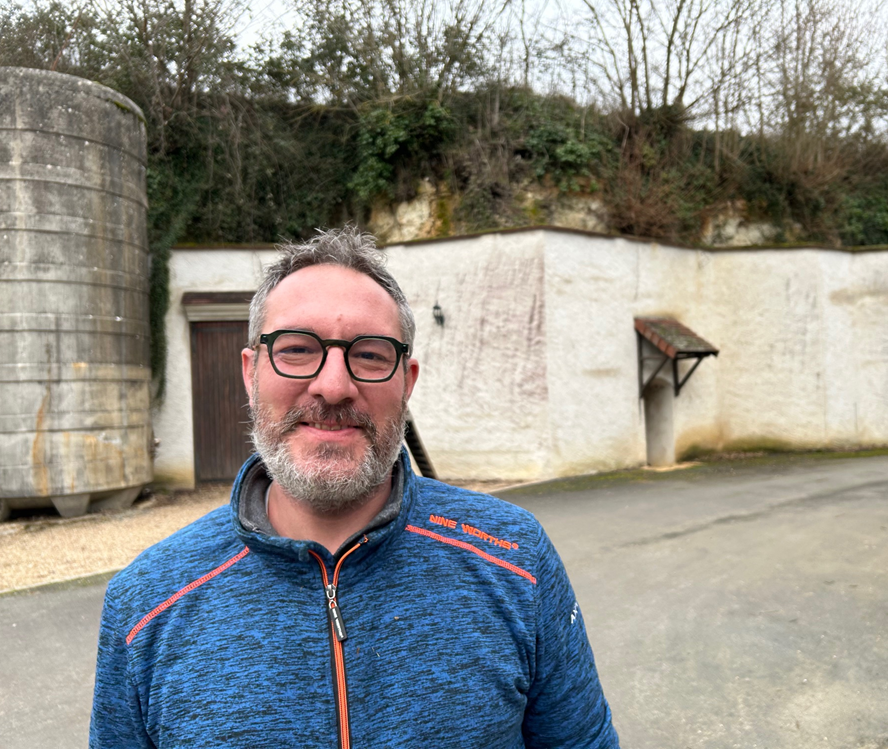
He favors vinifications in steel and in neutral 500L barrels. He doesn’t fine and only filters lightly if a wine doesn’t undergo ML and has enough residual sugar to be of concern. For operations in cellar and in vineyard, he follows the lunar calendar, but he’s quick to say that he’s not a biodynamic farmer, that such steps take years of observation and he hasn’t reached that point of decision yet.
His label combines the images of a toque blanche (a chef’s hat) and a wine glass.
The Wines
| Wine | Blend | Description |
|---|---|---|
| Les Trois Chênes | Chenin Blanc | Starting with vintage 2023, the Trois Chênes cuvée became the first wine in Benjamin's range of Vouvrays. The name comes from three oaks that grow on a rise in the middle of the parcels, which amount to roughly 7.5 acres and have an average vine age of 50 years. The soil is clay-limestone with flint. As with all of his wines, this is allowed to ferment spontaneously, and normally is neither fined nor filtered. The élevage takes place in steel. Production averages 1,000 cases. Tech sheet here. |
| Le Bouchet | Chenin Blanc | Le Bouchet is the name of the lieu-dit where this parcel is on the première côte of Vouvray. The vines average 50 years of age, the parcel is 1.35 acres, and this is vinified and aged in older 400L barrels. It was bottled in June following the harvest. Production averages 800 cases. Tech sheet here. |
| Les Grandes Dames | Chenin Blanc | This is the name of two adjacent parcels in close proximity to Hüet's Clos du Bourg parcel. The vines here average 80 years of age and grow in clay-limestone with flint. In cooler years, Benjamin puts the wine in neutral 500L barrels for some nine months of élevage; in riper years, aging can be done in a mix of wood and steel with proportionally more in steel. This is his top cuvée. Production averages 800 cases. |
| Méthode Traditionnelle | Chenin Blanc | Ben's vintage méthode champenoise. Ferments are native, and three-fourths of the wine is raised in steel over winter and one-fourth in older 400L barrels. The wine is bottled en tirage in March and left to age on its lees for 12 months before disgorgement. No dosage. Tech sheet here. Tamlyn Currin in jancisrobinson.com on Loire sparklers: I've left my personal, entirely-not-objective best for last. Vouvray is not even trying to be champagne, or any other sparkling wine in the world, in the way that Crémant de Loire and Saumur perhaps are. Vouvray sparkling wines seem to be the most transparent transmitters of terroir and vintage; they taste of their stones and they taste of their rain; and they taste of their sunshine and hay and honey and flowers. But even in a lean, cold year, Vouvray sparkling is not about cold-shoulder, catwalk sinews-and-bones austerity that Saumur edges towards. Vouvray wines seem to want connection; they are the wines that lean into the food rather than cut across it; they are the wines that celebrate with you rather than etch the celebratory message on a stone. These Vouvray fizzes are the kind of wines you could go through bottles of if you had a pig on a spit, but, equally, you could curl up on the couch in your slippers with a bowl of butternut or carrot soup and that damn Vouvray fizz would be bizzing in your ear, happy as a bee. You could share it. Or not. |