St. Innocent, Willamette Valley
California and Washington DC regional sales only
| Region | Oregon |
| Appellation | Willamette Valley |
| Producer | Mark Vlossak |
| Founded | 1988 |
| Website | https://stinnocentwine.com/ |
This year’s lineup from Mark Vlossak at St. Innocent Winery was a big standout in my recent Willamette Valley tastings… St. Innocent is also doing a fantastic job with sparkling wine. Pricing at this estate remains fair, especially considering the high caliber of the wines.
—Eric Guido, Vinous Media, July 2025
These judiciously oaked Pinots, which in this case do not show like the spawn of hot years, are consistently in the upper tier of New World Pinot Noir, especially if one favors elegance over power. Vlossak’s pricing regimen is also truly Old World in its fairness, which deserves a tip of the hat.
—Josh Raynolds, Vinous Media, February 2022
Mark Vlossak grew up tasting wine at the side of his father, whose most passionate hobby was wine. He was a wine educator and imported fine wine on the side for a group of buddies, which resulted in a truck pulling up to the house in Wisconsin to unload 300 cases of wine twice a year.
After a postgraduate degree in medicine, Mark moved to Oregon to practice pediatrics. In 1983, he was inspired by a quote from André Tchelistcheff, “The greatest sparkling wine in America will be made in Oregon.” Mark decided he wanted to do that. This led to five years of study, including graduate seminars at UC Davis followed by a two-year apprenticeship at Oregon’s Arterberry Winery. In 1988, he founded St. Innocent Winery, named for his father, who was born on All Innocent’s Day and christened with the middle name of Innocent.
He’s long been guided by a European sensibility. Ten years after starting his winery, he went to Burgundy on the first of many such trips, where he came to understand that the innate qualities of great Pinot Noir don’t come from the more-is-better philosophy that guided so many of his new world peers back in those days. Intensity of extraction, for example, didn’t result in a more powerful wine (just a bigger, clunkier one). By the turn of the century, he was known for wines of nuance and layered richness, many from what are now among Oregon’s most respected sites.
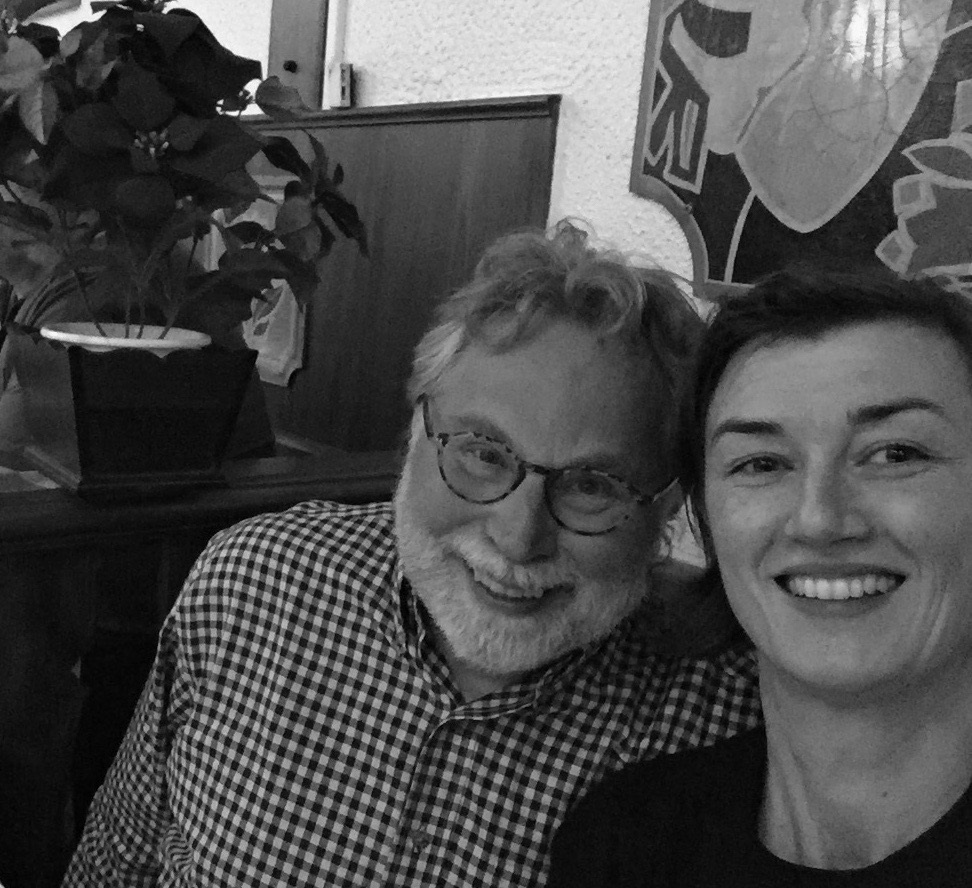
Mark (pictured above with Alsace’s Mélanie Pfister in 2019) was the winemaker at Panther Creek from 1994 until 1999, when he decided to go full time at St. Innocent. In 2007 he moved out of the tiny winery he had built in an industrial park in Salem to a state-of-the-art facility deep in the Eola-Amity Hills. It was called Zenith Vineyards, and St. Innocent bought an interest in this LLC during its conceptual phase, allowing Mark to design and build the winery from start to finish. In 2017, wishing to be unencumbered by partners, he sold his share in Zenith and bought a 47.5-acre property in the South Salem hills.
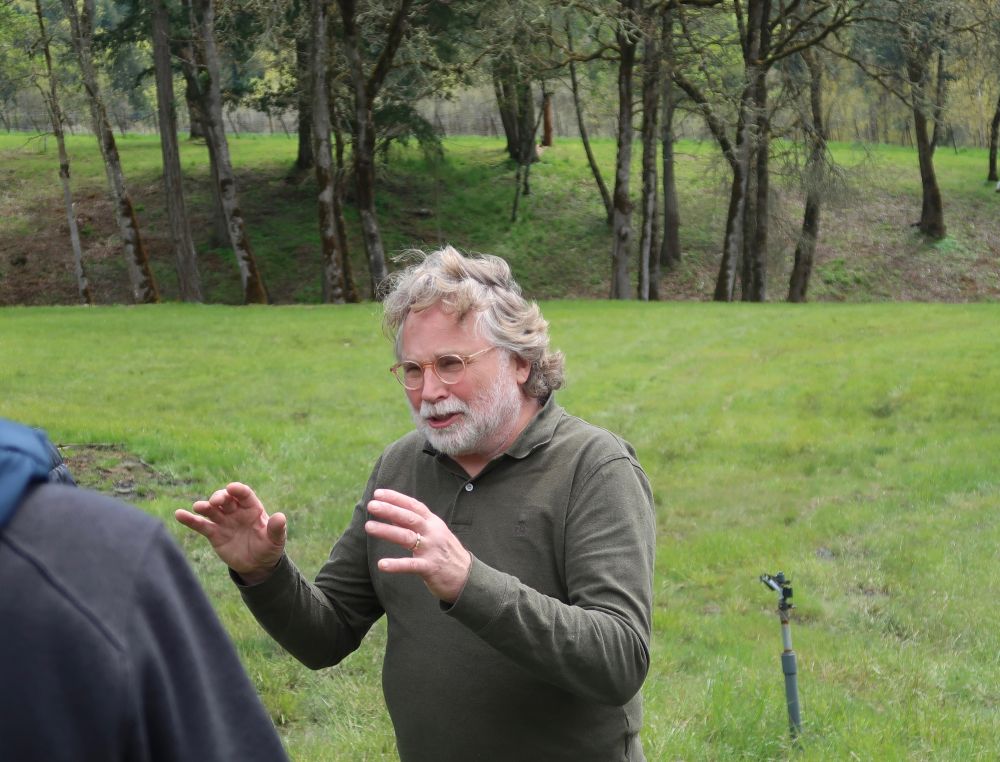
There, with the help of his close friend, the viticulturist Mimi Casteel, he planted a vineyard plus an apple orchard to produce cider to distill into apple brandy and built a new winery. He’s come full circle back to owning his own place, with the enormous plus of having an estate vineyard. He planted it one vine at a time via a drilled hole, all 15.5 acres, without bulldozing or grading, let alone plowing, meaning that virtually none of the soil and its microbial life was exposed to light or oxygen—and made the parcels organic from the start.
In the process, he downsized his production by nearly 40%. His focus remains on Pinot Noir—it comprises some 70% of what he makes—from the Freedom Hill, Momtazi, Shea, Temperance Hill vineyards, plus beginning with the 2023 vintage from his home vineyard of Enchanted Way. In addition, St. Innocent produces Chardonnay, Pinot Blanc, and small amounts of Riesling as well as méthode traditionnelle sparkling wine.
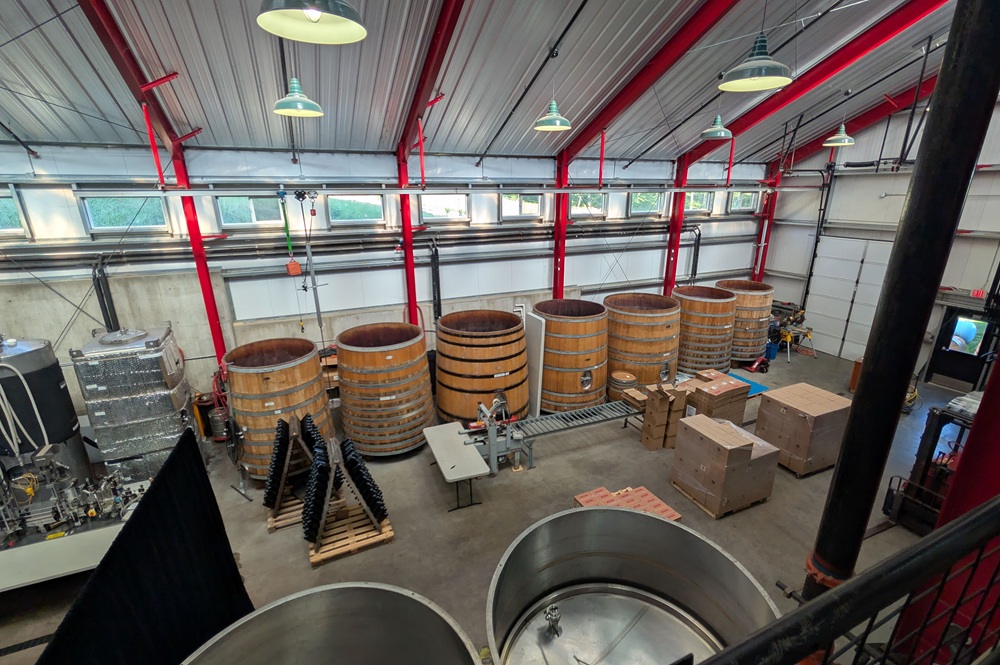
Mark’s beloved open-top oak fermenters.
The Wines
| Wine | Blend | Description |
|---|---|---|
| Temperance Hill Riesling | Riesling | Mark has long adored Mosel Riesling, especially at the Kabinett level (or drier) because of its acidity and ability to go with food. He persuaded vineyard manager Dai Crisp to plant Temperance's sole block of Riesling in 2014--all 1.3 acres of it. Facing northeast, the block grows on a hilltop at 850' of elevation in the vineyard's thinnest soils. The soil is volcanic and in this block's basalt soil are blue crystals. The harvest is early, and the style of the wine is trocken. The alcoholic ferment is mostly natively (Mark adds a tiny amount of neutral German yeast as insurance, but no SO2 until well after ferment is completed). No malolatic fermentation because the ph is too low. Élevage is ~6 months in steel on the lees, followed by one year in the bottle before release. Production averages 200 cases. |
| Freedom Hill Pinot Blanc | Pinot Blanc | The Freedom Hill Vineyard was first planted in 1982 by Dan and Helen Dusschee in what is today’s Mt. Pisgah AVA. Phylloxera reared its ugly head in 1995, necessitating a painful replanting, but also giving the Dusschees, now veteran viticulturalists, a welcome chance to completely change spacing, trellising, and orientation. The vineyard is one of the state’s most western, a warm site facing east but with quite cold nights, growing in ancient marine sediments. The Dusschee’s kids, Dustin and McKenzie, have taken over the management of the vineyard. Mark first made Pinot Blanc from Freedom Hill in 1997. These days the wine is a mix from tank with 20-25% from 1,000-liter Slovenian acacia foudres, blended after eight months of aging on its lees. Malo typically happens naturally. Production averages 700 cases. Tech sheet here. |
| Freedom Hill Chardonnay | Chardonnay | Mark has been making Chardonnay from this site since 1992. He works with two blocks of Dijon clones, one planted in 2006 and 2007 with the 76 and 548 clones. Over the years he has modified his winemaking, and now lets his ferments start spontaneously without SO2 or bacteria additions (a small amount of SO2 is added at bottling). Ageing is for twelve months on the lees—no stirring—in entirely neutral barrels, which are never moved once wine is inside of them. No fining, only a light filtration, and bottled by gravity. Production averages 1,100 cases. Tech sheet here. |
| Villages Cuvée | Pinot Noir | Villages Cuvée is St. Innocent’s calling card, a compelling Pinot blend from top vineyards at an honest price. The winery’s production of single-vineyard Pinot Noir is intentionally limited, and what remains goes into this Cuvée (it would be a mistake to think this is simply the lesser barrels of the single-vineyard wines—the “lesser” ones are splitting hairs and they are outnumbered by excess production). Wine from St. Innocent’s home vineyard of Enchanted Way became part of the blend for the first time with vintage 2023, along with wine from Freedom Hill, Temperance, and Shea. Tech sheet here. |
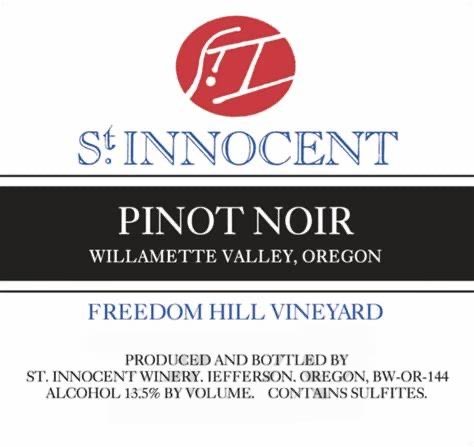
| Freedom Hill Pinot Noir | Pinot Noir | The first vintage of Freedom Hill Pinot Noir for St. Innocent was 1994. Today Mark works with three blocks: two acres of Pommard; two acres of Wädenswil; and three acres of 777. As with all of the St. Innocent Pinot Noirs, the fruit for this is de-stemmed but only minimally crushed, leaving 30-40% whole berries, and fermentations begin spontaneously in large stainless tanks without SO2. After several days, an extremely small amount of a mild strain of German yeast is added to the side of a fermenter, without being mixed in; this is Mark’s insurance policy against stuck ferments (which can require radical interventions), and the amount and strength of the yeast is such that it is not an inoculation so much as a reinforcement for the fermentations that have already begun. Aging is for 16 months in barrel with a maximum of 25% new wood. No fining, only a light filtration, and bottling is done by gravity. Note that all of St. Innocent Pinot Noirs open significantly with air, and decanting is recommended. Freedom Hill consistently produces some of the state’s most distinctive Pinot Noirs, with muscular structure, drive, and dark fruit profiles. St. Innocent’s production averages just under 1,000 cases. Tech sheet here. |
| Momtazi Pinot Noir | Pinot Noir | Moe Momtazi got his engineering degree in the US, returned to Iran, and then fled after the revolution. With his pregnant wife, he made his way back in the US via Mexico and applied for political asylum. They ended up in Oregon, where Moe started a construction firm, and then in 1997 bought an abandoned wheat farm that had sat idle for seven years. His father and grandfather had made wine in Iran, and this was a way to return to his roots. From the beginning, he put in his vineyard parcels without conventional chemicals, and by 2004 all of the vines (now 260 acres) were certified biodynamic by Demeter. The AVA is McMinnville. Mark first made Pinot Noir from the Momtazi Vineyard in 2006. He works with five blocks, a total of 8.1 acres planted to clones 777, 115, 667, and Pommard. These vines are the highest on Momtazi’s steep hillside at 680-760 feet above sea level. As with Freedom Hill, the soils are uplifted marine sedimentary loams and silts, mixed with volcanic soils (admittedly, this is odd; back when this land was ocean floor, a volcanic eruption cracked the seabed, and lava poured out, mixing with the sedimentary soil). But at Momtazi the topsoil is much more shallow than at Freedom Hill, especially higher up the hillside. Plus, the afternoon wind is a force to reckon with. The site is seven miles west of McMinnville, on the north side of the opening of the Van Duzer Corridor that cuts through the coastal range and funnels cold air into the Willamette Valley. With the first scent of this wine, the extremes of exposure, temperature shifts, and shallow soils make themselves felt—the aromatics grab you and demand attention. Production ranges from 900 to 1,100 cases. Tech sheet here. |
| Shea Pinot Noir | Pinot Noir | Dick Shea planted his first vines in 1989 and today his vineyard has 140 acres. He sells fruit to a who’s who of Oregon producers. Farming is sustainable, and for the ten years that Shea participated in USDA’s Conservation Security Program it made the top 5% of farms who were awarded best practices. Mark made his first Shea Pinot Noir in 1994. His grapes come from 6.3 acres in two hillside parcels, both growing in shallow marine sedimentary soils. One parcel faces southeast at 450-500 feet, planted with Pommard and 115, and the other faces southwest on a very steep slope planted with the Pommard clone. The wine is consistently full-bodied, complex, and age-worthy. Production averages 1,000 cases. Tech sheet here. |
| Temperance Hill Pinot Noir | Pinot Noir | Temperance was established in 1981 and since 1991 has been managed by Dai Crisp, who moved it to organic footing. It was certified in 2012 (and is certified salmon safe). It’s the highest vineyard in the Eola side of the Eola-Amity AVA, and the coolest of the sites that St. Innocent sources, losing direct sunlight by 5 or so in the afternoon. The vines grow along the spine of the Eola-Amity hills in and around a caldera of an ancient volcano. The volcanic soils are a mix of Nekia, Rittner, and Jory. Some 25 wineries source from its 100 acres of vines. Mark began making Pinot Noir from Temperance in 1994. He works with 9.2 acres in two blocks, ranging from 650 to nearly 850 feet, planted in dense parcels to Pinot Noir (Pommard, Wädenswil, and 667). The wine is classic Eola-Amity with its balance, spice, and perfume laced with smoky highlights. Production averages 1,000 cases. Tech sheet here. |