Domaines Minchin, Menetou-Salon
| Country & Region | France, Loire Valley |
| Appellation(s) | Menetou-Salon |
| Producer | Bertrand and Louise Minchin, François Mallet |
| Founded | 1988 |
W ith each vintage, [Bertrand Minchin] refines his style, and his now hand-harvested reds are among the best in the region. His beautifully structured whites are also gaining in precision…his Menetou wines are remarkably precise.
—Bettane & Desseauve, Guide des Vins 2019
Bertrand Minchin was born in the old province of Berry, the historic heart of the central Loire that included Sancerre and whose capital was Bourges. He grew up in the hamlet of Crosses, where his family farmed cereals, but from an early age Bertrand found wine far more interesting. Following his studies in 1987, he took over the two hectares of vines his grandfather had maintained just to the north in the Menetou-Salon appellation—specially, on the heights overlooking the village of Morogues, a stone’s throw from the Sancerre AOP border.
His desire to make wine from the fruits of his labor led to a protracted battle with the authorities to get licensing for the family compound (bought by his grandparents after the war—its house was once a monastery, and mass was held in the chapel up until 1945), because Crosses lay outside of the appellation. He went on to convert an outbuilding into a chai, planted vines in Morogues to add to Grandpa’s, and produced his first vintage in 1988. He named his nascent enterprise Domaine La Tour Saint-Martin. A generation later, with his daughter Louise at his side, the name changed to Minchin. (The plural form of Domaines Minchin is used because in 2004 Bertrand purchased a small estate in the Valençay Appellation; we work only with the Menetou-Salon wines.)
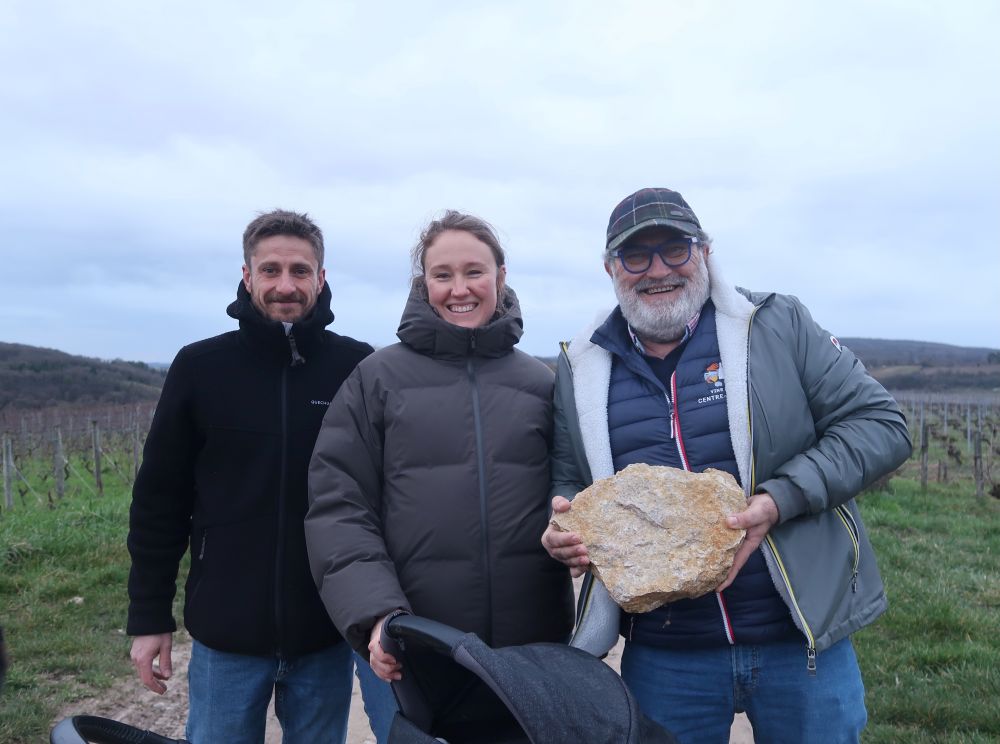
Louise Minchin with her husband, viticulturist François, and her father Bertrand (unseen: baby in stroller!).
Menetou-Salon the appellation—named after the village with the highest concentration of growers—traces its viticulture back to the 11th century, at least as far as the written record is concerned. Today the AOP consists of ten parishes, with the most important being three that stretch west to east in a more or less continuous line: Menetou-Salon itself, Morogues in the middle, and Humbligny (touching AOP Sancerre) to the east.
Morogues is a ten-minute drive from Montigny, which anchors the southwestern corner of the Sancerre appellation. The underlying geology here is Kimmeridgian limestone, and the Morogues hills are considered to be Menetou-Salon’s best terroir for white wines by virtue of its preponderance of calcareous soils. Morogues gives Sauvignon its citrus and stone whereas the soil in neighboring Menetou-Salon emphasizes floral components. For its part, Humbligny’s terroir is known for clay and thus its Pinot Noirs.
A 2019 census pegged Sancerre at 3,000 hectares of vines, dwarfing Menetou-Salon’s 602 hectares. It’s a testament to the success of Menetou’s Pinot Noir, however, that at the time of the census 27% of the appellation was planted to that variety compared to Sancerre’s 18%.
Bertrand and Louise farm close to 18 hectares of vines: 10.80 (nearly 27 acres) of Sauvignon in Morogues and 6.85 (17 acres) of Pinot Noir in Humbligny for their various cuvées of white and red. The viticulture has been organic since the early 2000s; they went for certification in 2019 (granted in 2022 after the typical 3-year trial period). All the vines are harvested by hand, a fact that stands out in this region of machine harvesting. The style chez Minchin is low octane and precise while paradoxically delivering a textural complexity across the range that leaves one eager for the next sip.
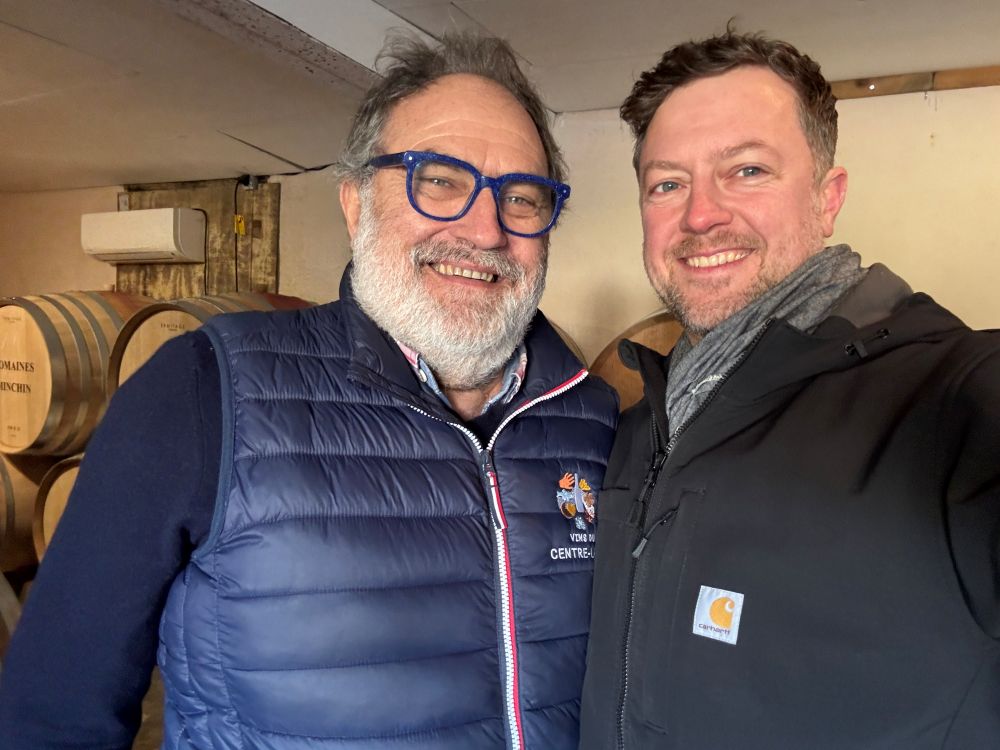
Bertrand with V59’s Mike Daniels.
The Wines
| Wine | Blend | Description |
|---|---|---|
| Morogues | Sauvignon Blanc | This is the first of three main cuvées of Sauvignon the domaine makes and the most important one in terms of volume. All of the grapes come from parcels in the Morogues heights, growing in various expositions on the same stony calcareous slopes as Bertrand’s buddy Paul-Henry Pellé (among the 30-odd producers in the appellation, only a handful concentrate on quality, with Minchin and Pellé leading the charge). The harvest is overseen by Louise’s husband, François, the viticulturalist; the grapes are harvested in small crates, stacked in one of several vans that make the run between Morogues and Crosses. Bertrand oversees the fermentations, which for this cuvée takes place entirely in steel. The ferments start with a neutral yeast and finish wild, and the élevage lasts well over winter. The first bottling is around Easter the following year and production averages 55,000 bottles or 4,500 cases. |
| Pommerais | Pinot Noir | Over the years, Bertrand fine-tuned his extraction methods and these days his touch with Pinot Noir is decidedly light. This wine comes from two parcels in Humbligny, one named Pommerais; ferments are spontaneous in large tronconique oak uprights, and the wine aged in those same uprights. Every year a small percentage of stems are included (15% for vintage 2023 for example; less in 2024). The parcels total 4.30 hectares (10.5 acres), and the average production is 30,000 bottles or 2,500 cases. |