Limnad, Finger Lakes
Washington DC Regional Sales Only

| Country & Region | Finger Lakes |
| Producer | Nancy and Mike Irelan |
| Founded | 2002 |
| Website | www.limnadwine.com/home |
In 1994 Nancy Irelan graduated from UC Davis with a Ph.D. in what was then the little-known field of grape genetics and physiology. She parlayed her degree into a job with Gallo, the world’s largest wine producer by volume and a company with the resources to create an entire department around her. The team of scientists she assembled became a kind of Delta Force, dedicated to investigating vineyard and cellar issues and problem-solving them. She stayed with Gallo for twelve years, rising to VP of Viticulture & Enology R&D.
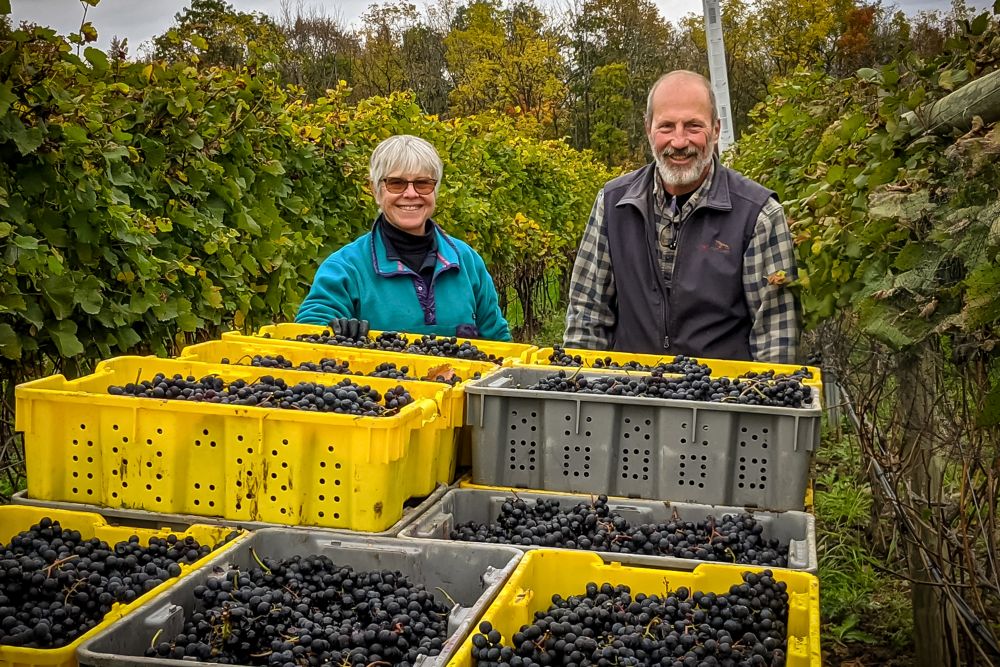
In 2002, her husband Mike and she embarked on their own project. Taking into account climate, soil and land prices, they focused on the Finger Lakes. Nancy knew the region thanks to collaborations on projects she headed up for Gallo with Cornell’s College of Agriculture and Life Sciences and with USDA. After much study and soil analysis, they narrowed their search down to Seneca Lake—the deepest of the Finger Lakes at just over 600-feet, and the second longest at 38 miles—and in 2004 purchased land on its northwest side. The land faced east and lay a stone’s throw from the lake’s shore and its deepest, widest section.
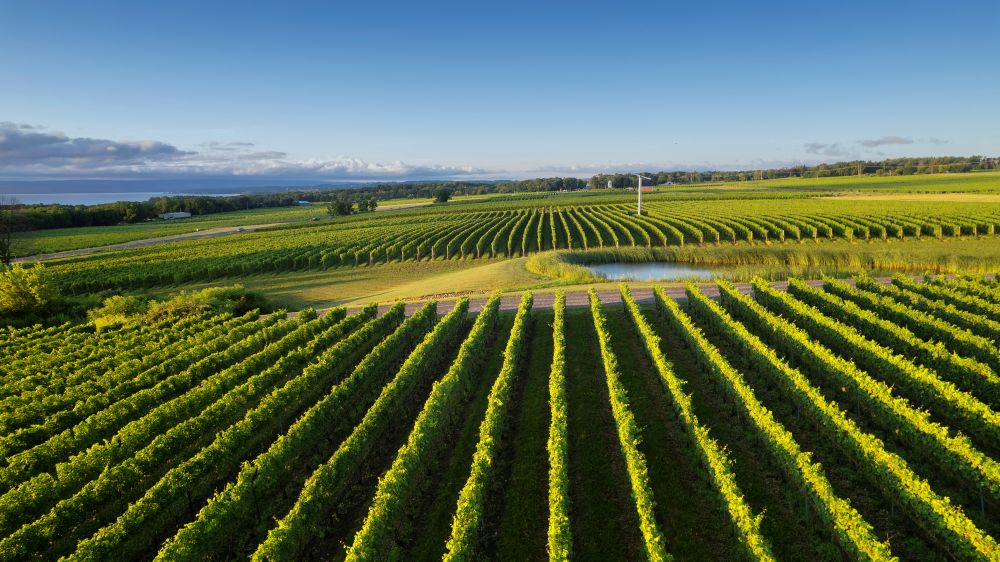
As hoped, the site gives them a layer of insurance against fall frosts. The deep lake absorbs heat over summer, and during harvest its proximity and depth keep their vines several degrees warmer than points further afield as the lake releases a warming blanket of fog on cold mornings. By springtime, the lake is significantly colder, having released a lot of its heat to the cold winter air passing over (ie, lake effect snow). Under these circumstances, its proximity to Limnad’s vines offers cooler air and retards the effect of early heat waves. This radiant cooling effect can delay spring budbreak and prolong dormancy, keeping tender shoots from pushing too early and being damaged by spring frosts.
From the beginning, Nancy and Mike (she in the cellar and him in the vines) were aligned with regenerative viticulture. The winery they built in 2009 operates on geothermal power for all heating and cooling; only biodegradable products are used in the cellar; and all winery waste is recycled or composted. The facility is the only LEED Gold certified winery in NY state. The estate has 53 acres of land, of which 34 is planted to vines, and the entire production comes from their own vines.
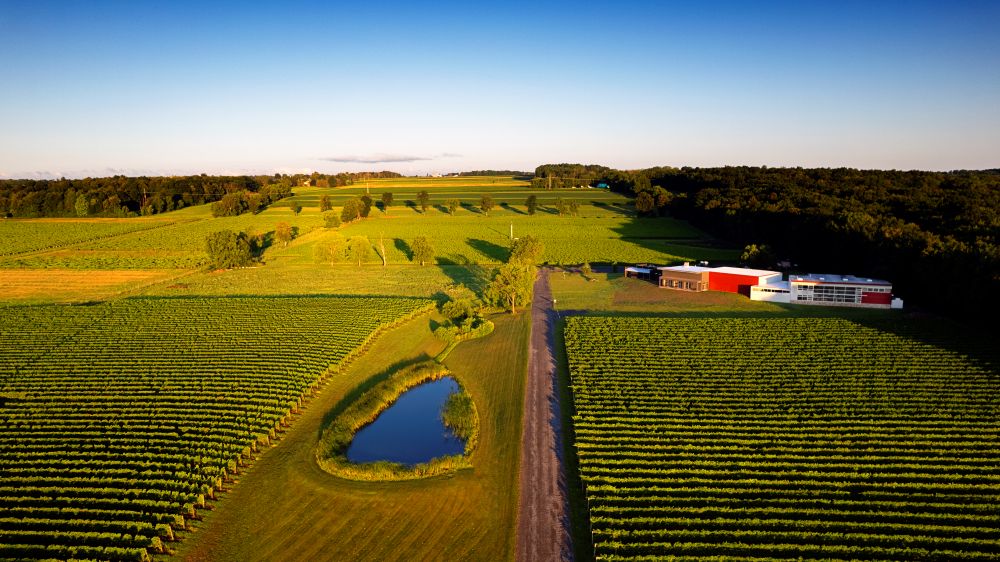
The vineyard grows overtop of paleozoic layers, preserved with the sedimentary bedrock formed by ancient seas (see the PowerPoint presentation linked at bottom of this page for more on this and on the lake’s effects). The soil is heavily influenced by glaciers and contains random mixtures of limestone, shale and calcareous sandstone. The Estate vineyard also has heavier clays mixed in with its till and alluvial deposited by the ancient glaciers.
In the vines, no herbicides are used (instead, a mechanical weed knife is employed). The vineyard soils are heavy clay and glacial till, easily compressed, and Nancy and Mike are keen to encourage a healthy and diverse population of micro-organisms to provide underground porosity and facilitate the exchange of air and water with root systems. Consequently, organic and Demeter certifications were not pursued due to their reliance on copper sprays as a primary disease control agent, and the resulting risk of accumulation and toxicity within the soil microbiome.
The couple’s first line of defense against fungal disease is meticulous canopy management—cane thinning and positioning, cluster thinning and leaf plucking—to maintain air flow and reduce relative humidity within the fruit zone. Concerning applications, Mike works primarily with elemental sulfur to keep powdery mildew at bay. Other products are used to control fungal diseases and fruit rots depending on a given disease pressure and on the fruit maturation, and all of these applications break down quickly.
Their first harvest was in 2006, a mere half a ton of Pinot Noir which Nancy presciently made into sparkling Blanc de Noir and bottled under the Red Tail Ridge label. Even so, the Red Tail Ridge brand was always intended for still wines (with a couple of fun sparklers); Limnad, which saw its debut in 2025, is the label Nancy and Mike dedicate to their serious sparkling wine.
By 2012, they knew that their site was ideal for sparkling wine. The Finger Lakes occupy a cusp of ripeness zone for viticulture, and the cold climate gives its grapes fabulous natural acidity. Nancy well knew too that the area, one of the oldest wine-producing regions in America, had based much of its early wine production in the 19th century on sparkling wine for the very same reason. So, in 2012 the couple decided to lean into sparkling wine by earmarking vineyard blocks and investing in the specialized equipment and space such production required. By 2020 they were ready to take the leap, letting a range of wines age for a proper four long years en tirage, or on the lees in bottle, before disgorgement.
With the spring of 2025, they unveiled their first release: four vintage 2020 méthode champenoise wines and two méthode ancestrale wines (aka, pétillant naturel or pet-nat). The former spent four years on the lees in bottle, after a patient élevage over winter and going well into summer following the harvest. In colder years, a portion of the Chardonnay and Pinot Noir may be raised in wood and undergo ML; in warmer years, steel is favored for élevage and ML may be blocked in some or all tanks. Riesling, by contrast, is strictly raised in stainless steel without undergoing malo.
The Pinot Noir Pet Nat is released more or less immediately, sometimes while still fermenting, and the Riesling Pet Nat is tiraged for six to twelve months before undergoing a crude disgorgement to remove the heavier sludge that could mute Riesling’s aromatic purity and flavor components.
As to the name, a Limnad is both a freshwater nymph and a nature spirit in Greek mythology. In spirit form, a Limnad can assume various incarnations, and is a protector of its water and of the surrounding land—keeping frost at bay, for example!
The Wines
| Wine | Blend | Description |
|---|---|---|
| Sparkling Riesling Pet Nat | Riesling | The grapes are hand-harvested, pressed whole-cluster, and only the free run and initial light pressings are used for this and all of Nancy’s sparkling wines. Ferments are spontaneous and the wine is not filtered, fined or sulfured. This Riesling ages on its lees in bottle for six to twelve months before disgorgement. Production is quite small and the initial disgorgement and release was only ~100 cases. |
| Sparkling Pinot Noir Pet Nat | Pinot Noir | Like the above, the grapes are hand-harvested, pressed whole-cluster, and only the free run and initial light pressings are used for this (and all of Nancy’s sparkling wines). Ferments are spontaneous and the wine is not filtered, fined or sulfured. The Pinot Noir Pet Nat sees very little if any time en tirage. Production is quite small and the initial disgorgement and release was only ~100 cases. |
| Riesling Extra Brut | Riesling | For this and all of Limnad’s méthode champenoise wines, a neutral Champagne yeast is used to finish the fermentation to ensure dryness. This underwent four years of aging on the lees before disgorgement. As with the three wines below, dosage is 2-3 grams per liter depending on the vintage, and final SO2 count is altogether minimal: around 10-15ppm or less. Production is quite small and the initial disgorgement and release was only ~100 cases. |
| Blanc de Blanc Extra Brut | Chardonnay | As with the two wines below, this was raised in tank or wood (it depends on the vintage) over winter to early summer, and then spent four years of aging on the lees in bottle before disgorgement. Production is quite small and the initial disgorgement and release was only ~100 cases. |
| Blanc de Noir Extra Brut | Pinot Noir | Four years of aging on the lees before disgorgement. Production is quite small and the initial disgorgement and release was only ~100 cases. |
| Sparkling Rosé Extra Brut | Pinot Noir | Four years of aging on the lees before disgorgement. Production is quite small and the initial disgorgement and release was only ~100 cases. |