Landmass Wines, Oregon
California and Washington DC regional sales only

| Region | Oregon |
| Appellation | Columbia River Gorge, Willamette Valley, Rogue Valley |
| Producer | Melaney Schmidt and Malia Myers |
| Founded | 2018 |
| Website | www.landmasswines.com |
M elaney Schmidt and Malia Myers are the couple behind Landmass, so named because they buy grapes from growers in diverse geographies, i.e. land masses, and they wanted to bring attention to their commitment to express these sites through winemaking.
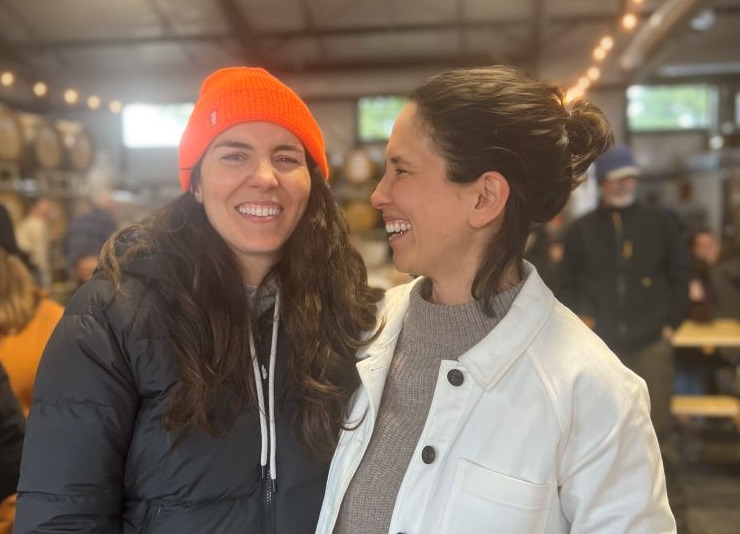
They met in Los Angeles. Melaney came from rural southern California and was working as a bartender and a GM in hospitality; Malia hailed from Colorado and was working in the entertainment industry, building props and sets. As they entered their thirties, they wanted a change. Wine intrigued them, but it also intimidated them—it had a way of feeling too high-brow and pretentious, which wasn’t what these two were about. What felt right to them about wine was the hands-on growing and making of the stuff, and on the spur of the moment in 2015 they took a road trip to Illahe Vineyards in Oregon. Melaney had written the winery to say how much she liked one of their wines, and they replied with an invitation to visit. That was all the prompt they needed.
They arrived in the evening and set up tent next to some vines. They had permission, but hadn’t planned on pulling in in the dark of night, and when they climbed out of their sleeping bags the next morning the idyllic setting bowled them over. It was harvest too, so they volunteered to help for the day and the winery graciously accommodated the two greenhorns. The hook was set, and they returned the next year as interns to help with the entire harvest.
From 2016 to 2018 they worked at Illahe Vineyards. In the same period, Melaney went to community college in Oregon to learn the nuts and bolts of winemaking. In 2018 they launched Landmass with 60 cases of sparkling wine that they had finished and bottled for Illahe, and that Illahe didn’t know what to do with and so sold to this intrepid duo.
In the years that followed, they made their wine in three different cooperative production facilities, each larger than the last as they outgrew the rented space. An eye-opening visit to a cidery in the Columbia River Gorge convinced them to relocate there in 2021. Once again, it was the landscape that hooked them—in this case the rugged hills and palisades of the gorge and its dynamic as a wind tunnel. Moreover, in the town of Cascade Locks, they could rent space at a flat rate rather than based on production tonnage, a significant factor for a budding business. And they were between their favorite vineyard sources: Oregon’s Rogue Valley and Willamette Valley, and Washington’s Underwood Mountain across the river.
From 2020 to 2024, they went from vinifying 13 tons to 122 tons of grapes. Malia’s carpentry skills and Melaney’s mechanical skills—which she learned at the hand of her father, a master BMW motorcycle mechanic—proved to be invaluable. They became adept with all four methods of making sparkling wine: forced-carbonation, pétillant, charmat, and tradition (or méthode champenoise), and they do every step in-house (except the riddling and disgorging of their traditional method wines, a time-consuming endeavor done off-site). Each method has advantages that can be tailored to a specific wine.
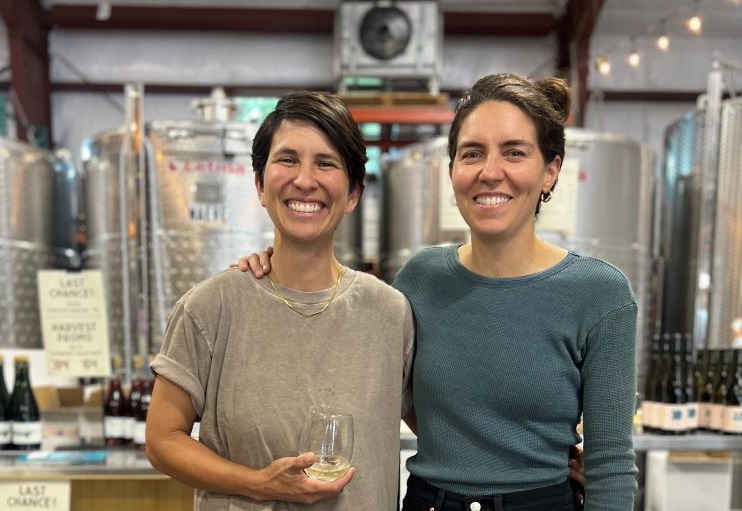
They make a bit of still wine too, but they like to call themselves the queens of pop because it’s the sparklers that make them the most proud. They’ve gone to lengths to demystify sparkling wine and to make it accessible as an everyday drink (among other advantages, the first three production methods outlined above allow for affordable pricing) rather than a special occasion wine.
But what really gives them legs to stand on is the fact that they built their thriving company from the ground up all by themselves.
The Methods
Force-carb: still wine injected with CO2. This method retains freshness and brightness, allowing a focus on fruit and youthful vibrancy. It’s the quickest to market, the most affordable, and reaches the broadest market. Requires specialized equipment and clear understanding of how pressure and temperature impact dissolved CO2.
Pét-Nat or Pétillant Naturel: CO2 is captured during fermentation (starts off in tank and continues in bottle). A wilder, more rustic style of sparkling that tests the hand and capabilities of the winemaker during active fermentation because once bottled, nature is in control. Can be quick to market but essentially continues to age sur lie until opened. This means the wine is constantly evolving. Geared toward alternative, adventurous drinkers. No specialized equipment required, but an understanding of fermentation kinetics must drive the winemaking.
Charmat (aka, Prosecco method): A highly calculated style of sparkling production. The wine’s final fermentation is controlled in tank, capturing CO2 while aging sur lie in a stainless-steel pressure vessel. 11 months total production time. No variation between bottles as the entire lot is homogeneous from start to finish. These wines are driven by fruit aromas with a modest yeast impact. Extremely specialized tanks, filters, pumps, and equipment required. Yeast is filtered out under pressure to achieve a brilliant wine.
Traditional (aka, Champagne method): Secondary fermentation is captured in bottle. Extremely methodical. Primary fermentation occurs in neutral oak (in Landmass’s case; others use steel vessels) and then the wine’s final fermentation is captured in individual bottles. Production time exceeds three years. Following initial fermentation, the wine is bottled en tirage to rest horizontally for maximum yeast impact, which drives the wine’s profile and puts the focus on secondary aromas rather than fresh fruit. Requires specialized equipment. Yeast is removed by disgorging each bottle rather than filtration.
The Wines
| Wine | Blend | Description |
|---|---|---|
| Vintage RU OK? Pétillant Naturel | Chardonnay | Melaney and Malia created RU OK? during the pandemic to check on friends and loved ones. To this day, the wine’s youthful optimism inspires them. The fruit comes from two vineyards in the Willamette Valley: half from a site based on loess overtop of basalt in the Laurelwood AVA, and half from marine sediments in the Chehalem Mountains AVA. Like all of their wines, this starts off fermenting spontaneously and finishes dry with a very small addition of neutral, non-GMO yeast. Fermentation is completed in bottle and sediment is natural. |
| Vintage Sparkling Rosé of Tempranillo | Tempranillo | From vines organically farmed in marine sediments in the Eola-Amity Hills. Native ferments aided midway with a bit of neutral yeast (typical for all of their wines) and raised in stainless steel. ~800 cases. Tech sheet from the domaine here. |
| Vintage Heavy Glow Sparkling Rosé | Pinot Noir with Chardonnay and Pinot Gris | From three dry-farmed vineyards on the extremely windy bluffs of the Columbia River Gorge. The specific site is Underwood Mountain, and the vines are organically or sustainably farmed on basalt soils ranging from 1,400 to 2,000 feet in elevation. The Pinot Noir was raised in steel with partial malo; the Chardonnay and Pinot Gris were raised in neutral oak without malolactic fermentation. Bottled with 4 vol/liter of forced carbonation and 3g/l of residual sugar. Tech sheet here. |
| NV Brut | Chardonnay with Pinot Noir | A méthode champenoise wine made from Willamette Valley grapes. Fermentation takes place in neutral oak followed by aging on the lees en tirage for ~36 months before disgorgement. Less than 200 cases. |
| Vintage Blanc de Noirs | Pinot Noir | From a dry-farmed, LIVE-practicing vineyard in marine sediments in the Eola-Amity Hills. Raised in neutral oak for eight months with partial malo, and bottled en tirage to rest for ~36 months on the lees before disgorgement. Dosage 8g/l. Tech sheet here. |
| Vintage Chillable Red | Pinot Noir, Chardonnay and Tempranillo | The chillable red comes from multiple vineyards in Willamette Valley, all farmed organically. The Pinot Noir is aged in stainless steel and Tempranillo and Chardonnay see just five months in French oak. Tech sheet from the domaine here. |
| Vintage Multitudes | Pinot Gris and Chardonnay | Multitudes is from multiple vineyards in the Columbia Gorge characterized by volcanic soils. The wine is a blend of 75% Pinot Gris and 25% organic Chardonnay. The Chardonnay was aged in newer oak barrels and the Pinot Gris in stainless steel. Tech sheet from the domaine here. |
| Chenin Blanc Rogue Valley | Chenin Blanc | The Rogue Valley Vineyard is at 1900 feet of elevation tucked into the Wagner Creek Basin. The wine is fermented and aged in stainless steel. Tech sheet from domaine here. |