Violin, Eola-Amity
California and Washington DC regional sales only
| Region | Oregon |
| Appellation(s) | Primarily Eola-Amity |
| Producer | Will Hamilton |
| Founded | 2013 |
| Website | https://violinwine.com/ |
P ersonally, I can’t recommend Violin’s wines highly enough.
—Eric Guido, Vinous, May 2024
Will Hamilton comes from an old family in Hagerstown, an historic town and port of entry for Maryland’s northwest panhandle. Back in the day, it was a major hub in the middle of a huge trough of the Appalachians known as the Hagerstown Valley, which led south to Virginia’s Shenandoah Valley and north to Pennsylvania’s Cumberland Valley. Will still speaks with a measured mid-Atlantic drawl.
As a young man, he went down to the University of the South in Sewanee and got a degree in humanities. From there, it was but a small step to throw himself into the culture of wine, moving to Oregon in 2005 where he persuaded the Erath Winery to take him on for harvest. This began his deep dive into Oregon winemaking and viticulture.
Following that first harvest, he got a job with Laurent Montalieu at the Northwest Wine Company in McMinnville, Oregon’s largest custom-crush facility. The operation made wine for dozens of clients, and in five years Will went from the packaging room to the cellar, and from cellar master to becoming assistant winemaker. He made hundreds of wines with over 15 different varieties from all over the state as well as from Washington. In the meantime, he attended countless conferences, undertook courses in winemaking, and fell in love with the Eola-Amity AVA.
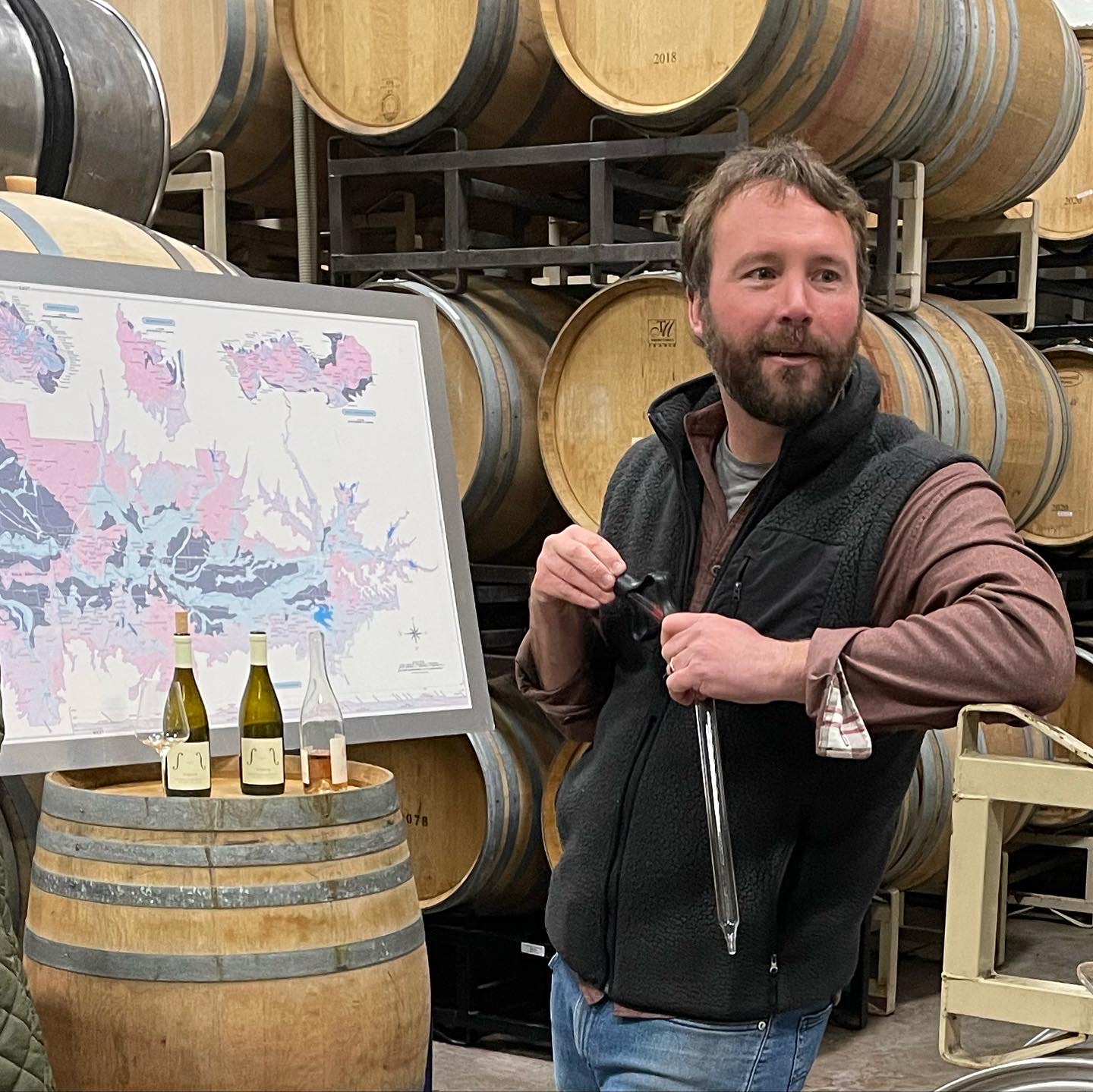
In 2011 he joined a buddy’s mobile filtration company, which gave him leeway to take a harvest job with Evening Land. Specifically, its Seven Springs Vineyard, a legendary site in Eola-Amity with a winery directed by a Burgundian team doing barrel-fermenting Chardonnay, something which Will had barely touched upon during his previous job. He learned the fundamentals from Isabelle Meunier, Dominique Lafon’s right hand at Seven Springs in what they called the “White Cellar,” a room dedicated to fermenting white grapes. Here he also met Ken Pahlow and Erica Landon, who were using the winery to make their nascent Walter Scott wines while Ken worked for Evening Land. It was there too that Will was exposed to hands-on viticulture and how it related directly to winemaking. He ended up working production for two harvests at Seven Springs.
In 2013 he moved into Ken and Erica’s new little winery next to the Justice Vineyard, trading labor for space in order to start making a few hundred cases of his own wine under the Violin label (2013 was Violin’s first “official” vintage). In 2015 he left the mobile service company to take a technical sales gig with Pacific Winemaking, traveling all over the Northwest to offer enological consultation, support and technology. In that capacity, he talked to all manner of growers and producers. Some he had met during his custom crush job, others with the mobile filtration company, the rest were new relationships. All of them gave him the confidence to go forward with Violin.
Will chose the name Violin because it was deeply personal to him. At Sewanee, he learned the poetic art of using a figure of speech in which part of something represents the whole–as in f-holes, referring to the violin family of instruments, or to BB King’s Gibson (Will was a big fan). Will’s son is named Olin, the word vino is in violin, and when we think of violins we think of elegance, beauty, and craftsmanship, all of which can be wrapped up in how we think of Pinot Noir.
Will stayed with Ken and Erica until 2017, when he outgrew the facility, and moved his barrels over to leased space in the GC Winery in Amity, where he’s been ever since. In January 2018, he quit his day job with Pacific Winemaking to go full time with Violin, and with that year’s harvest he made the first Violin Chardonnay. By 2022, he had grown to 2,500 cases, which for him is about the maximum where he can still do everything by himself and do it well. That is his wheelhouse.
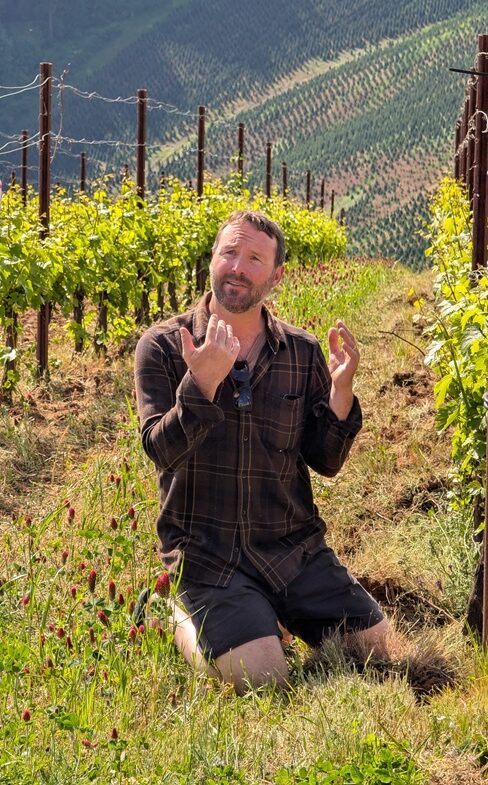
His heart, as stated earlier, is in the Eola-Amity hills, a “volcanic island at the end of a wind tunnel.” (The tunnel being the Van Duzer Corridor that cuts through the coast range, allowing moderating oceanic winds to funnel into the Willamette Valley.) Of the nine growers he buys grapes from, seven are in these hills. All nine embrace dry-farming, and that is pretty key to Will. Like his buddy Ken Pahlow, he’s keen to have both Chardonnay and Pinot Noir vines shoot thinned early, aiming for moderate yields in the range of 2.75-3.25 tons per acre, to have vines focus energy on less fruit to ripen sooner. Good acid retention is fundamental, and he favors early picks over later picks to best capture a sense of freshness in the wines.
He hasn’t used commercial yeast in any vintage, and since 2018 avoided any nutrients or yeast supplements. His Chardonnays go into barrel as juice and undergo fermentation in wood (selections of French barrels, both 228 and 500 Liter with some 10-20% of the total new) for around 12 months, then spend 4 months in steel. Malo happens as it wants and isn’t blocked, finishing its slow conversion by January or February in most years. Cold stabilization occurs naturally via ambient temperatures over winter. He uses an average of 10-15% whole cluster with Pinot Noir ferments, but of course this depends on the vintage and the site (his Justice Vineyard Pinot Noir is usually entirely de-stemmed). Ferments are normally complete within 15-20 days; he favors higher temperatures over intense maceration and extraction. These days his Pinot élevages run around 14 months in barrel, perhaps a little longer for certain cuvées. Both colors are lightly filtered at bottling, but never fined.

The Wines
| Wine | Blend | Description |
|---|---|---|
| Chardonnay, Willamette Valley | Chardonnay | Barrel-fermented Chardonnay blended from Sojeau Vineyard in the Eola-Amity hills and Bracken Vineyard in Eola-Amity Hills. The former brings richness and power against the brisker and more slender frame of the uphill blocks at Bracken. Fermented and aged in stainless steel. 250 cases. Tech sheet for vintage 2024 from domaine here. |
| Pinot Noir, Willamette Valley | Pinot Noir | This is Violin’s largest production, reaching as much as 900 cases. Well over three-quarters of the wine comes from acclaimed sites scattered about the Eola-Amity hills, with a dollop from First Man Vineyard in the North Valley (in some years, the portion of the blend from outside Eola-Amity Hills is under the 5% cap, meaning that Will could label this as Eola-Amity rather than Willamette Valley). Typically, the élevage goes for about 14 months in barrel on the lees, then close to two months in steel. ~775 cases. Tech sheet from the domaine for vintage 2021 here. |
| Pinot Noir, Polk County | Pinot Noir | The Eola-Amity AVA can be rendered essentially as a rectangular zone running north-south. The northern third is in Yamhill County; the southern two-thirds fall into Polk county (the legal border runs on a straight horizontal). Will’s Polk County bottling is Pinot Noir sourced from various sites in the southern part of the Eola-Amity AVA. Production can reach as much as 400 cases. Tech sheet from the domaine for vintage 2022 here. |
| Pinot Noir, Sojeau Vineyard | Pinot Noir | From two acres of vines planted in 2007 using three clones—Dijon 115, Wadensville and Pommard—in the high western heights of Eola-Amity. Will ferments the three clones together, filling as many as 17 barrels, about six of which go into this single-vineyard bottling. After more than 14 months in barrel, the wine rests another six weeks before bottling. Production can reach 150 cases. Tech sheet for 2022 vintage from the domaine here. |