Division Wine, Willamette Valley
California Sales Only
| Region | Oregon |
| Appellation | Pacific Northwest |
| Producer | Tom and Kate Monroe |
| Founded | 2012 |
| Website | divisionwinemakingcompany.com/ |
For readers looking for unadorned and precise Pinot Noir, this is an address to know.
—Josh Raynolds, Vinous Media, February 2022
Midwestern boy Tom meets Kate, born in Bahrain to a father from England and a mother from Madagascar, and so begins a story…
They drank a bottle of Oregon Pinot when they first met. Subsequently they tasted wines all over California and in 2009 moved to France where Kate translated and where an enologist friend of a friend gave them an intensive, hands-on winemaking education in Beaujolais. When they weren’t learning how to make wine in Beaujolais, they went south to taste in the northern Rhône, and north to taste along the Côte d’Or.
Then they lived for a while in Kate’s family house in the Loire, where they made wine and explored all manner of local, juicy, low-alc vin de soif made of Gamay or Cab Franc, or various Pinots, Sauvignons, Chenins, Chards (the Loire has it all, even Malbec or Cot, a grape that by all reckoning ought to be a failure so far north and, indeed, usually was back in the day but now it’s better; now, sometimes, it’s really good, even when it grabs you by the throat).
Tom is from St Louis and is an avid fan of rock bands, live music, and skiing, the latter helping to explain why he went to business school in the Bay Area. That in turn helps explain why he wrote a business plan for a winery in Oregon. After B school, he ended up taking a disappointing job with a big bank.
Kate is from England, Switzerland, France, and America. She had been all over the world and ended up in college in upstate New York before heading west, where she developed a taste for wine and an eye for design (check out those nifty labels).
From the Bay Area, they moved to NYC, and Tom continued with the suit and tie in corporate finance. One day, pretty early on in NYC, Kate said, What’s with the big bank? Tom shrugged, and in his heart of hearts he totally agreed, so he quit the big bank. They got themselves a black dog and took off to France (with the dog) to learn to make wine. After all was said and done, they landed on Oregon as the place to be, and Kate got a job managing affairs for Penner-Ash Cellars while Tom landed a job working alongside the winemaker at the Methven Family Vineyards.
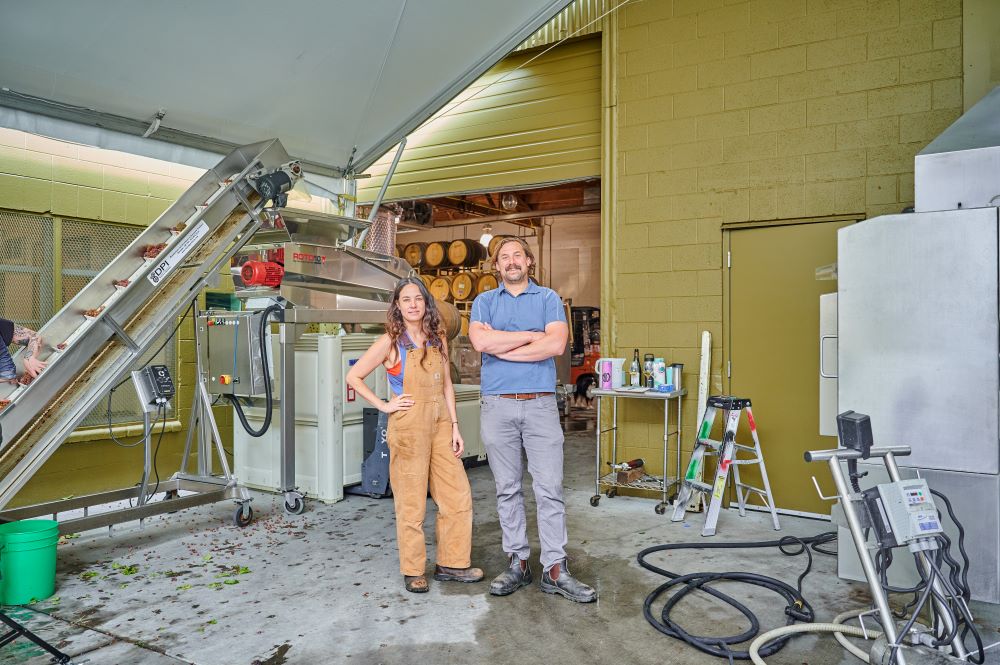
In 2011 Tom went back to France to help out with a couple of harvests, most notably with Domaine Nudant in Corton; afterward, he raced back to Oregon to do the same. Shortly thereafter, he wrote another business plan. Kate and he put together some cash, and in 2012 they founded the SE Wine Collective in Portland. They built a winery in a warehouse, enticed three other brands to invest and make wine and share ideas and expenses under the same roof. In addition, they got a retail license to sell their wine on site, plus a bar license to serve their wine on site. All of this allowed them to pay their bills while making the wines they wanted to make. A bevy of wine in small batches followed, making Division quite a name for delicious, approachable Pinot Noir, Gamay and Chenin at stellar price/quality ratios. From the beginning, they concentrated on vineyards farmed with the best environmental practices, and they’ve always favored spontaneous ferments over inoculated ferments.
Then the pandemic took hold. Once the dust began to settle, the landlord decided to jack up the rent, so Tom and Kate moved Division in 2021 and the SE Wine Collective ceased to exist. Division is now housed near the Willamette River, two miles west of its original location, in a building it owns.
Back in 2012, Kate and Tom began life with two tiers: Division and Division-Villages. Division is the flagship, reserved for the more “serious” or age-worthy wines; Villages is for those wines inspired by the vibrant vins de soif of the Loire.
In subsequent years, they added two ranges: Gamine, for wines Kate makes; and Nightshade, for wines (mainly Nebbiolo) Tom makes. In 2024, they added Ouest (west, both literally and in pronunciation) to concentrate on lesser-known varieties grown predominantly in organically-farmed sites in Washington and fermented spontaneously.
Overall production averages 8,000 cases. The hallmark of all of their wines is their lovely, pure aromatics, plus their sheer drinkability and ease, for these wines are nothing if not comfortable in their own skin.
The Wines
| Wine | Blend | Description |
|---|---|---|
| Division "Un" | Chardonnay | The grapes are from Willamette Valley: Royer Vineyard, Cassin Vineyard, Johan Vineyard and Eola Springs. Soils are volcanic based. Division varies the ripeness levels to coax different profiles from each of the sites. From a mix of younger and older vines, harvested on the early side to accentuate freshness. The wine is fermented with indigenous yeasts. A small amount of sulfur is added following spring after malolactic fermentations, and it is aged in French oak barrels and puncheons for nine months and then one month in stainless. ~500 cases. Tech sheet here. |
| Division "Trois" | Chardonnay | From the Johan Vineyard in the Van Duzer Corridor AVA, a site farmed biodynamically and subjected to constant diurnal winds sweeping through the corridor from the Pacific. The vines were planted in 2002 and grafted over to the Draper clones brought over from Meursault and originally planted in the Eyrie Vineyard (which is where the budwood came from for the grafting). Like most of Division’s white wines, this too is picked on the early side. Production ~50 cases. |
| Division "Quatre" | Chardonnay | From the Royer Vineyard in the Eola-Amity AVA, harvested in two passes and raised in older puncheons on the lees but without stirring. Production ~75 cases. |
| Division L'Orange | A mix of white grapes that can include Pinot Gris, Riesling, Roussanne, Chenin Blanc, Gewurztraminer, Sauvignon Blanc, Chardonnay and Aligoté. | From the Carousel Vineyard in the uplands of the in the Columbia Valley’s Yakima Valley comes this celebratory harvest wine—which really is a great tradition, albeit one that has been badly commercialized in our day. Kate and Tom adhere to the traditional third Thursday in November to release this wine, made without fining or filtration or pretension and meant to be drunk young with a slight chill. Tech sheet here. |
| Division "Nouveau Nouveau" | Gamay Noir | From the Carousel Vineyard in the uplands of the Columbia Valley’s Yakima Valley comes this celebratory harvest wine—which really is a great tradition, albeit one that has been badly commercialized in our day. Kate and Tom adhere to the traditional third Thursday in November to release this wine, made without fining or filtration or pretension and meant to be drunk young with a slight chill. |
| Division "Lutte" | Gamay | Mostly from the iron-rich soils of the Eola-Amity hills and blended with sources from the Willamette Valley. Lutte is French for struggle, in this case the struggle to convince the larger American public that Gamay is indeed a varietal to take seriously! As usual, normally all ferments are spontaneous, and they’re a mix of whole cluster carbonic, semi-carbonic, and traditional de-stemmed fruit that sees a short aging of ~8 months in older wood and concrete. Production is ~400 cases. Tech sheet here. |
| Division “Un” | Pinot Noir | The grapes are from Willamette Valley: Cassin Vineyard, Jubilee Vineyard, Armstrong Vineyard, Johan Vineyard, Eola Springs Vineyard and Temperance Hill Vineyard. The majority of the fruit is grown in volcanic soils, with some from marine sedimentary. Based on the Cassin Vineyard in the Yamhill-Carlton AVA, this is a blend of Pinot from various sources made with an eye to elegance and drinkability. It’s raised in a combination of barrels and concrete tank, and punches above its Willamette Valley designation. Tech sheet here. |
| Division “Deux” | Pinot Noir | Vintage 2022 is the last from the original vineyard Kate and Tom started with in 2010: the Eola-Amity Vineyard, planted in 1972 and having some of the oldest Pinot vines in the AVA, but riddled with phylloxera and torn up after the ’22 harvest. Biodynamic farming. ~75 cases. |
| Division “Trois” | Pinot Noir | From a small 0.85-acre block planted to Pommard clones with Dijon 777 in the upper section of the well-known Temperance Hill Vineyard. Farming is organic and the AVA is Eola-Amity. Production ~60 cases. |
| Division “Cinq” | Pinot Noir | From the Armstrong Vineyard in the Ribbon Ridge AVA, one of Oregon’s highest. Dijon 667 and Pommard clones, native ferments with some whole cluster, and aging in one new barrel and one old barrel. This is wine that could evolve well in the cellar. ~50 cases. |
| Division-Villages Méthode Carbonique Pinot Noir | Pinot Noir | From the cool temperatures of the Willamette Valley, this wine is made entirely with whole clusters to create carbonic maceration environment, which decidedly accents the juicy, crunchy, yummy side of wine. It’s aged six months mostly in steel but also with some old barrels for texture. Production ~500. Tech sheet here. |
| Division-Villages “L’Isle Verte” | Chenin Blanc | Sourced from the Columbia Valley, this wine is brought up in neutral wood (both standard barrels and 500L puncheons), plus stainless steel barrels. Classic Chenin, with taut electricity, plenty of orchard pit fruits, and lanolin. A crisp white wine. Production ~200 cases. Tech sheet here. |
| Division-Villages Rosé of Gamay Noir “L’Avoiron” | Gamay Noir | A Villages wine inspired by the rosés Tom and Kate drank in northern France. L’Avoiron is the name of the volcano near the vineyard where Tom and Kate worked in Auvergne. The grapes come from the Carousel Vineyard (formerly part of the Willard Farms) in Yakima Valley from a six-acre block picked relatively early with more acid-driven grapes and lighter red fruit. The mineral-intense soils were formed from volcanic Miocene uplift against basalt bedrock that is layered with a primary topsoil made up of quartz and lime-silica. The wine is fermented and aged in stainless steel and bottled unfined and unfiltered with minimal SO2. Tech sheet here. |
| Division-Villages Gamay Noir “Les Petits Fers” | Gamay Noir | A Villages wine AKA 'the little irons'. The grapes are mostly from Willamette Valley but also from one vineyard in the Columbia Valley, both with iron-rich volcanic soils. The wine undergoes carbonic and semi-carbonic maceration using significant amounts of whole cluster, except for the Columbia Valley Gamay, which is mostly destemmed and fermented spontaneously in an open-top vat. The lots are aged independently in mostly concrete tanks, stainless steel tanks, and some neutral barrels for six months. About 525 cases annually. Tech sheet here. |
| Division-Villages Béton | A unique mix of grapes for each vintage: Cabernet Franc, Côt (Malbec), Gamay, Cabernet Sauvignon, and Pinot Noir. | The heart of this wine is a Loire clone of Cabernet Franc from the Applegate Valley. The vintage dictates what additional grapes are added to the blend, and élevage is done primarily in concrete (béton in French). This is a terrific bistro wine, one with lots of joy. ~1,200 cases. Tech sheet here. |
| Division Gamine Pétillant | Grenache | From southern Oregon’s Applegate Valley AVA, specifically Mae’s Vineyard growing in granitic soils. Kate makes this pétillant from a rosé of Grenache, picked early for fresh lift. |
| Division Gamine | Aligoté | Burgundy’s “other” white grape, enjoying something of a renaissance now with the pricing of Chardonnay. This comes from the Pamar Vineyard in the Willamette Valley, a crisp, dry white wine. |
| Division Gamine | Grenache | From the Equus Vineyard in the Columbia Valley, this wine is fermented whole cluster to make an especially floral, savory Grenache. |
| Division Ouest Rosé | Gamay Noir | This comes from an organically farmed vineyard in the Columbia’s Yakima Valley. Soils are mixed: silt-loam, gravel, and basalt bedrock. Native ferments in steel with some whole cluster inclusion and aged for a short time in steel. Tech sheet here. |
| Division Ouest Red | Sangiovese, Nebbiolo, and Syrah | From three vineyards in the Columbia Valley, harvested early in the morning to make a bold, sun-kissed red with juicy acidity. Tech sheet here. |