Champagne Perrine Fresne, Sermiers

| Country & Region | France, Champagne |
| Appellation(s) | Champagne |
| Producer | Perrine Fresne |
| Founded | 2020 |
P errine Fresne (frein) made her first wine in Sermiers with the 2020 harvest. She inherited 7.5 acres but only used her finest plots amounting to 2.5 acres to make three cuvées, foremost among them being “Sarmate I”. Sarmate refers to an inhabitant of Sermiers, and the Roman numeral one signifies her first edition of this cuvée, buttressed with reserve wine from her father but made with the intent to express the best of her village in that vintage. She created a label premised on topography and the colors of autumn, her favorite season.
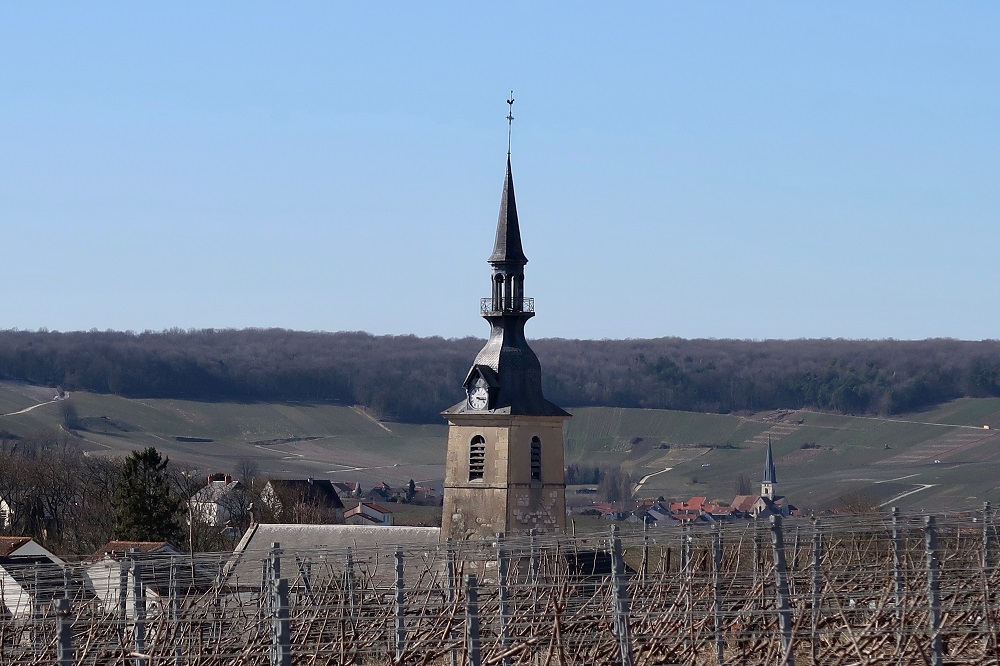
She pruned for moderate yields, used only the first pressing of the grapes, and let the wine rest on its lees in tanks for a nice relaxed élevage of ten months before bottling for the secondary fermentation. At disgorgement, she gave it two grams of sugar. She grew up helping her father in the vines and subsequently spent five years working with grower Champagne Nominé Renard while passing WSET levels 2 and 3 and earning degrees in wine marketing in Reims and winery management in Avize. Her father worked the French circuit of consumer-direct fairs and reliably sold what he produced. It’s important to understand that Perrine stood to inherit a successful family business. The moral problem confronting her was that she couldn’t get behind the product, so she elected to put the domaine on a starkly different course with all of its unknowns and obvious risks. She moved to a far more progressive viticulture program, to a much more Burgundian approach in the cellar, and to completely re-branding the business in her own name. With Sarmate I, she wanted a vinous Champagne above all.
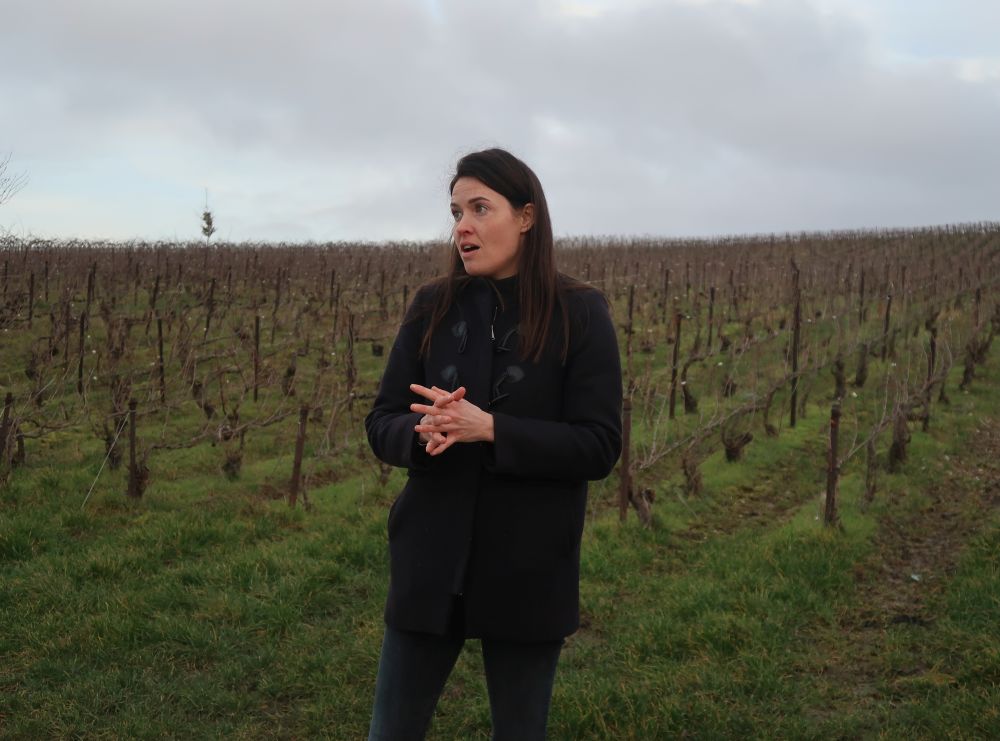
Her father worked some 22 acres that he split among his two brothers and his daughter upon his retirement. Perrine’s 7.5 acres divide into 11 lieux-dits, breaking down into 26 plots with about 90% of that growing in Sermiers, a village on the southern tail of the Petit Montagne de Reims; the remainder is in neighboring Villers-aux-Noeuds. Both are premier cru communes on the cool northern side of the greater Montagne de Reims, a mountain best described as a forested plateau, with vines on its various flanks. The terroir of Sermiers, located in a bowl with a notably cool microclimate, has a lot of sand in its limestone soils on top of chalk bedrock, and Pinot Meunier is a variety that thrives in cooler temperatures and lighter soils. Her 7.5 acres are consequently composed of roughly 50% Meunier, 30% Pinot Noir, and 20% Chardonnay. Their average age is 45 years.

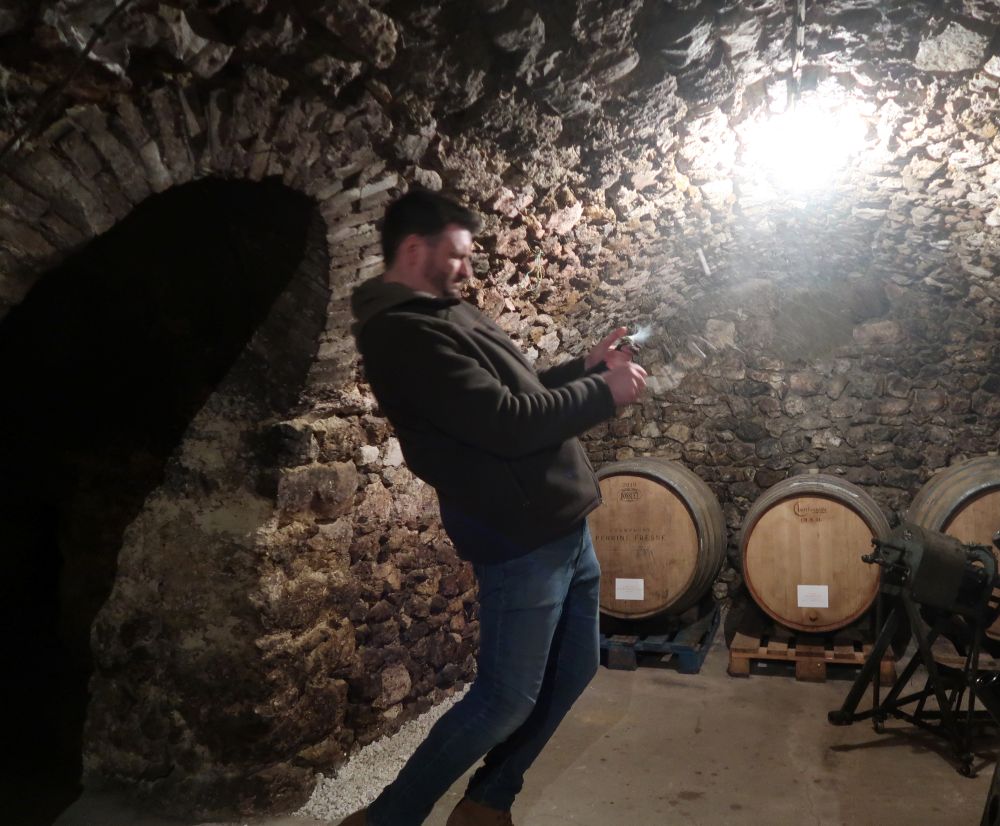
She works closely with her husband Kevin–that’s Kevin below disgorging a bottle in their cellar– whose day job is as export manager at a small house in the Marne Valley. She is one of three récoltants-manipulants in Sermiers, a village dominated by a co-op (by contrast, Écueil, just down the mountain, bursts at the seams with RMs), and the only woman among them. In the vines, she quit all use of pesticides immediately, and the 2.5 acres she’s currently reserved for herself are practically free of herbicides. She’s determined to stop all herbicides as soon as resources permit investments in new machinery and additional labor. Concerning fungicides, she adapts to each season, with a less is more approach. She’s altogether interested in organic and biodynamic treatments but is wary of certifying agencies and being hamstrung by their often overly restrictive policies.
After Sarmate I, several parcels stood out to her with the quality of their grapes, and now she makes single plot wines when a year merits their being singled out. The ethic with them is one plot, one grape and one year. In the cellar, in terms of barrels, she favors neutral 228L and 450L barrels from Burgundy’s Côte de Beaune (her current batch came from Domaine Leflaive), but she continues to use steel for some ferments and could well age another rendition of Sarmate entirely in steel, as she did with number 1, if she thought the year called for it. In warm years, she tries to inhibit malolactic fermentation and in cold years she encourages it. She’s only steadfast about racking; that’s always done by gravity.
The Wines
| Wine | Blend | Description |
|---|---|---|
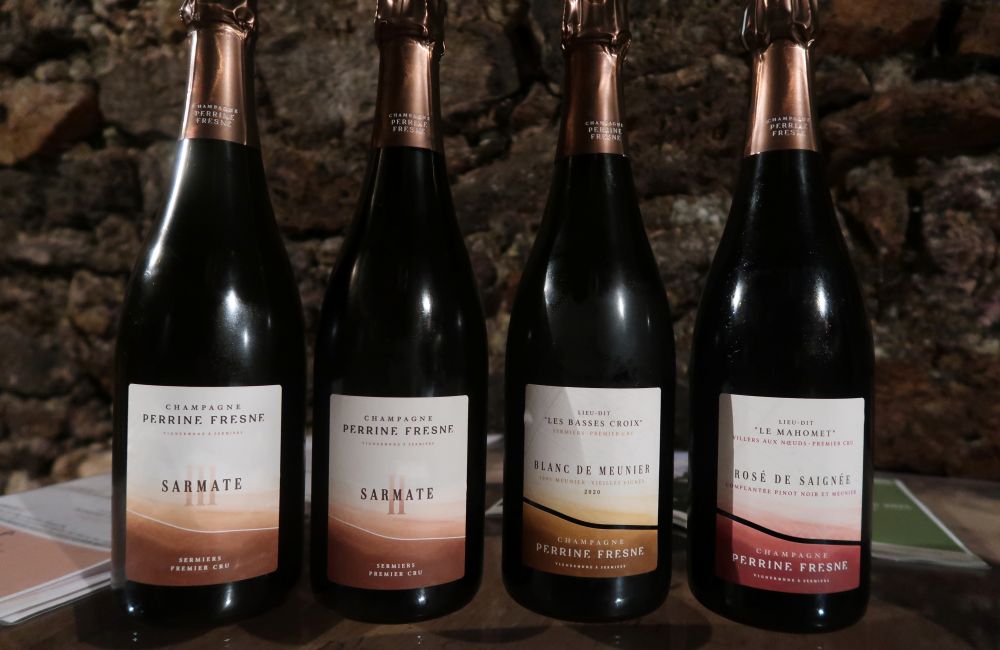
| Sarmate II Premier Cru | Chardonnay 42%, Pinot Meunier 40%, Pinot Noir 18% | Perrine's second rendition of Sermiers fruit, with three significant differences: less Pinot Noir and more Meunier, full malolactic fermentation, and the fact that all of the wine from vintage 2021 was fermented and élevaged in older 225L and 450L barrels. A fourth difference is that only half of the cuvée is from the base year of '21; the rest is from her own perpetual reserve started in 2020, reflecting the very short harvest of '21 due to the difficult growing season and consequent enormous sorting. The '21 fermented spontaneously, the lees were stirred during élevage, and there was no fining or filtration. 3,425 bottles with 3 grams of dosage. Tech sheet here. |
| Sarmate III Sermiers Premier Cru Extra Brut | 42% Chardonnay, 37% Pinot Meunier, 21% Pinot Noir | Perrine’s third rendition is composed of 85% from vintage 2022, blended with wine from her perpetual reserve. The vintage portion fermented spontaneously (malo too) in a mix of steel and neutral oak for a ten-month élevage before bottling en tirage. Disgorged July, 2025 and dosed with 2 g/l. 890/6-packs; 160 magnums. |
| Sarmate IV Sermiers Premier Cru Extra Brut | Meunier 43%, Pinot Noir 33%, Chardonnay 24% | The IV is 70% from vintage 2023 blended with her perpetual reserve. The wine fermented spontaneously in steel and wood, underwent full malolactic naturally, and was élevaged 60% in steel, 40% in 228 and 500L barrel for 10 months over winter. No fining or filtration and no cold stabilization. Disgorged in February 2026: 5,400 bottles with a dosage of 2.5 g/l. Tech sheet here. |
| Sarmate Perpétuelle | Meunier, Pinot Noir and Chardonnay | Perrine's first release of this cuvée came in 2026 from a perpetual reserve that she began with her first vintage in 2020. The reserve stock consisted of 2020 through 2022 with 25% of the wine coming from the base vintage of 2023, and all of it was raised in steel. Future releases of this wine will have reserve stock from wood. The first release was for only 500 bottles and was given a dosage of 2 g. Tech sheet from domaine here. |
| Les Noues 2023 Sermiers Premier Cru Rosé Extra Brut | two-thirds Meunier, one-third Chardonnay | Les Noues (new) is a rosé de saignée from a 0.27 acre parcel of Meunier planted in 1967 blended with 1/3 Chardonnay from just over a half acre planted in 1991. The Meunier was destemmed, crushed and macerated for 12 hours, and like the Chardonnay élevaged over winter in neutral barrel. Natural malolactic and bottled en tirage without fining, filtration, or cold stabilization. Disgorged in February 2026: 450 bottles with a dosage of 1 g/l. Tech sheet here. |
| Les Basses Croix 2021 Sermiers Premier Cru Blanc de Meunier Extra Brut | Meunier | Les Basses Croix is a lieu-dit of just under one acre planted to Meunier in 1967 and 1977. Ferments were spontaneous with natural malolactic, followed by élevage in neutral 500L Burgundy barrels for ten months. Like all of her wines, this was only moved by gravity and never underwent fining, filtration or cold stabilization. Disgorged in February 2026: 1,000 bottles with a dosage of 4 g/l. Tech sheet from domaine here. |