Terreno, Chianti Classico
| Country & Region | Chianti Classico, Italy |
| Appellation(s) | Chianti Classico, Chianti Riserva |
| Producer | Sofia Ruhne |
| Founded | In the 16th century; purchased by the Ruhne family in 1988 |
| Website | www.terreno.eu.com |
The first ever vintage of this single-vineyard [Sillano 2019] from up-and-comer, Sofia Ruhne is a stunner.
—Michaela Morris, Decanter Magazine, May 2023
The Terreno estate is run by the delightful Sofia Ruhne, who was born in Sweden but grew up in these forest-covered hills above Greve in Chianti…if you are not familiar with these wines, I strongly recommend that you seek them out.
—Monica Larner, The Wine Advocate, February 2023
I’ve said it before, but it bears repeating: Chianti Classico is certainly the most dynamic and exciting wine region in Italy today.
—Monica Larner, The Wine Advocate, July 2024
Sofia Ruhne made her first wine at Terreno in 2010. The next year she moved full time to the estate and four years later oversaw its transition to organic farming with her father. In 2015, she officially took over the estate from him. With the 2016 vintage, she earned an enviable 17.5 for her top Chianti from noted Italian expert Walter Speller (Fantastic balance of tangy acidity, ripe cherry and grainy tannins. Long and Pure. Real energy). For a woman in a strange land who had to overcome all manner of biases, that was an affirmation.
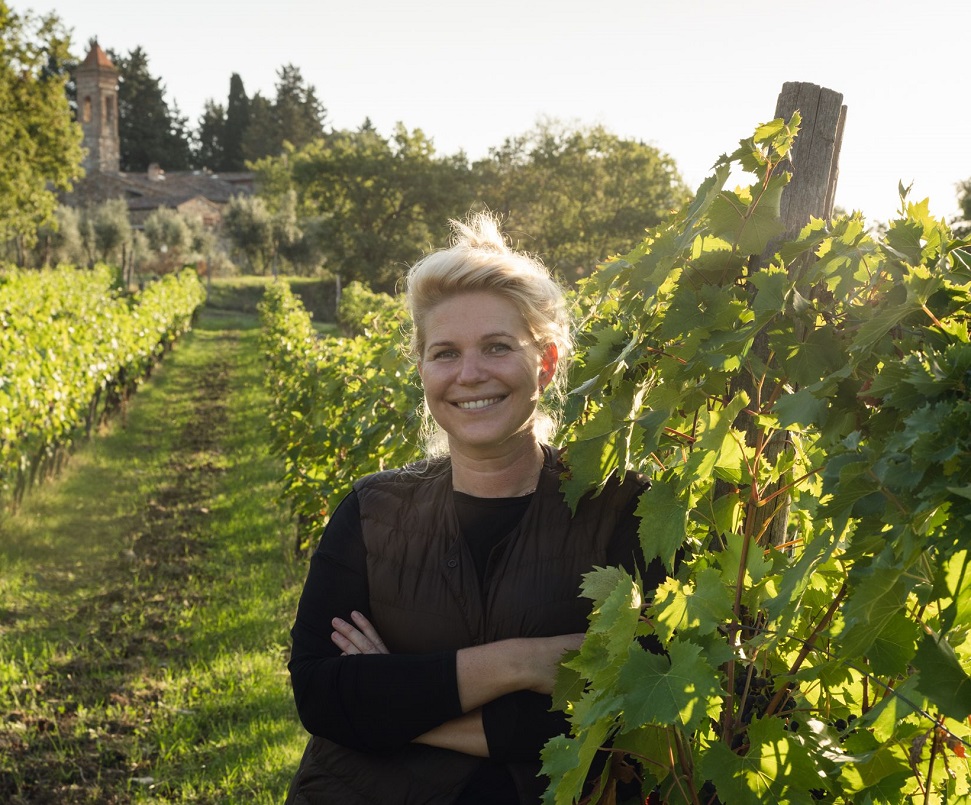
She’s the second-generation Swede to run Terreno in the hills outside of Greve in Chianti. Her first years were spent learning, initially entertaining a host of opinions from her male counterparts (notably not Dad, however), including the declaration that the estate needed a man in charge because no one would follow a woman. In the end, she replaced most of the staff and embarked on her own path.
This led to visits to key domaines up and down Italy and France to learn what she could to take back to Terreno. For her, it came down to a vineyard site and its wine; how to clearly and justly translate that connection. This began circa 2010 when she first got involved in the winemaking and proposed the cuvée that became known as ASofia. The name was a kind of inside joke, originally chalked on a foudre’s little blackboard identifying its contents by a cellar hand, meaning to Sofia, or perhaps more accurately, Sofia’s Trial. She wanted to make an experimental lot of pure Sangiovese Chianti Classico from the estates’ oldest vines, growing on one flank of the Terreno vineyard, in an era when this wasn’t done (except by a few intrepid producers such as Rampolla and San Guisto). She was told time and again that markets wouldn’t support such a wine, but she thought that was absurd; that if Sangiovese couldn’t be something as a pure varietal, then what did that say about Chianti Classico? She persevered, and the endeavor eventually resulted in customizing the viticulture to each of the estate’s parcels: altitude, soil, exposure, microclimate and the weather in a given season all now play a role in how each site is treated, and in how machinery is used (it’s worth noting too that she instituted a regiment whereby each of the estate’s five pruners got assigned a color, and every row of given parcel was correspondingly color-coded, so that each worker became responsible for their own rows year after year). In addition, she fenced off every parcel to protect them from deer and boars.
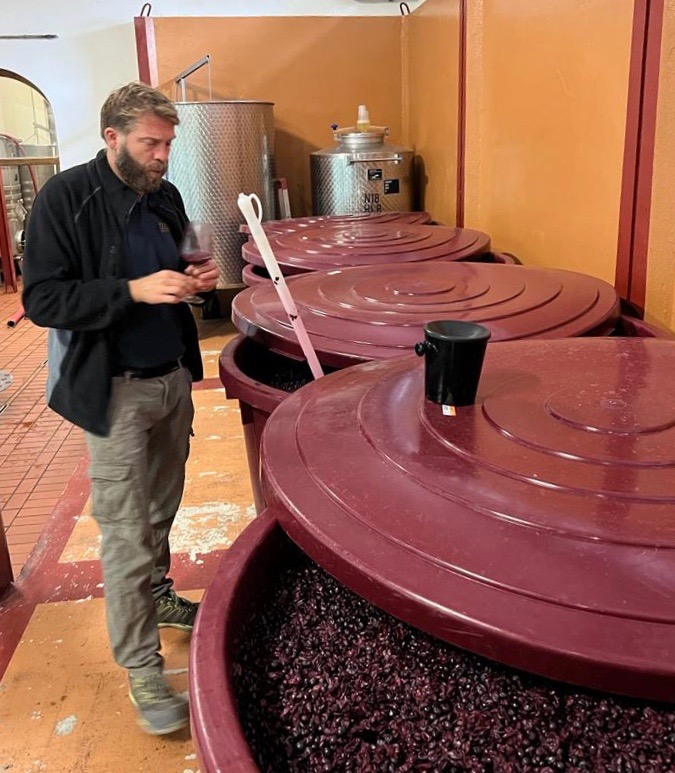
At harvest, micro-ferments in small batches are made not just of every plot but every clone, which in turn informs subsequent decisions to take in the vines. Below is her colleague Giacomo Fioravanti checking some of the micro-ferments during the 2022 harvest.
Sofia’s father had a career in shipping and caught the wine bug early on, falling in love with Italy and its wines. In 1988, a time when land prices in Chianti were well within reason, he and his wife bought Terreno. Essentially, they were romantics who had the hearts to take a chance, and they made their first vintage of wine the following year. They had the foresight to retain Federico Staderini in 1998 as a consulting agronomist and enologist, and Staderini stayed on until just after the pandemic. The key player with Sofia now is Giacomo Fioravanti, who came on full time at Terreno after ten years at Isole e Olena, where he was Paolo de Marchi’s winemaker. Prior to that tenure, Giacomo spent four years in the cellar at the historic estate of Capezzana, the leading producer in Carmignano.
The estate, in the hills on the eastern side of the Greve Valley, is composed primarily of forest with 50 acres of vineyards and 25 of olive orchards. There are three vineyard sites:
• Terreno: the home site at 300-350 meters, just over 17 acres of vines growing on opposing flanks running down the hillside. One flank faces south-southwest and grows Sangiovese for the classic as well as the estate’s white varieties. The opposite flank, facing northwesterly, grows the estate’s oldest vines from the early 1980s plus its youngest from 2018. The oldest go into the ASofia cuvée when the vintage merits it; otherwise they go into the classico blend like the younger vines. The geology is macigno and other non-calcareous marine sandstone soils, prized above all for the perfume they promote in Sangiovese.
• Le Bonille di Sopra: Their northernmost plantings, a terraced site at ~400 meters with nearly 20 acres of vines, facing south-southwest. Like Terreno, this is on the eastern side of the Greve Valley and grows on the flank coming off the long ridge of Monte del Chianti, Chianti’s highest mountain. Soil is mostly alberese and other calcareous soils with some galestro (foliated, friable schist) and clay. Plantings here are denser and date from 1982 to 2012.
• Sillano (Photo below with Sofia and V59’s Maria Castelli): The estate’s highest site at 500 meters, surrounded on three sides by forest with an olive orchard on the fourth. The vines were planted between 1987 and 2006, and face east-southeast. This parcel is on the western side of the Greve Valley, just outside of the medieval village of Montefioralle, in the Unità Geografiche Aggiuntive (“additional geographical unit”) of Montefioralle, one of the 11 UGAs of Chianti Classico. The name Sillano almost certainly stems from the famous Roman general Sillas, and it’s the name of a church next to Terreno’s home vineyards. It’s also the name of a calcareous sandstone–formazione di sillano–that identified a primary soil type of Montefioralle until more recent authorities declared that mistaken and identified the soil type as pietraforte in the continuation of Italian chaos. The two types are very close in age and makeup; more importantly, it’s rare to find vines in calcareous soils in Chianti. The soils, elevation (with coolness enhanced by both elevation and surrounding forest), and mature vines give this wine an intense mineral depth.

All the vines are harvested by hand in small bins, and all the ferments are allowed to happen spontaneously without yeast additions.
A word on the Chianti Classico zone: it’s right in the middle of the greater Chianti region, beginning just south of Florence (where it’s the most hilly and stony) and stretching nearly to Siena. Classico received DOCG status in 1984 as a subzone of Chianti; in 1996, it got its own DOCG. The Classico zone has a little over 173,000 acres, of which only 24,000 are planted with vines and of those only 17,000 are entitled to the DOCG of Chianti Classico. Elevations for vineyards range from 250 to 600 meters. The zone is around the size of the Mâconnais, but with far more forest–62% of the classico region is forested!–to say nothing of olive orchards and grain fields, making it a far cry from the monoculture that has come to dominate so many celebrated wine regions.
The Etruscans cultivated vines here. Cosimo III, the Grand Duke of Tuscany, delimited the first appellations—Chianti, Pomino, Carmignano, and Valdarno Sopra—in 1716. Fast forward to 1987, when the Chianti Classico Consorzio embarked on an ambitious undertaking named the Chianti Classic 2000 Project (although it ended up spanning 16 years) to upgrade its viticulture through extensive study in conjunction with the agricultural schools of the universities of Pisa and Florence. At the time, most vineyards dated from the 1960s and 70s, and were planted with clones prized for yields. Sixteen vineyard sites were selected for clonal trials along with 5 research cellars for vinifications. Ten weather stations were set up in the region to track micro and macro weather patterns. Trials were done with Sangiovese, Canaiolo, Colorino, and Malvasia Nero. Out of 239 clones, 24 of Sangiovese, 8 of Canaiolo and 2 of Colorino were chosen for vineyard test trials (with studies involving densities, trellis systems, soil management and rootstocks). From that, 8 clones were deemed ideal for Chianti Classico by reason of consistently smaller grapes, thicker skins, and more open bunches—all across a variety of climate conditions. These were 7 clones of Sangiovese and 1 of Colorino. It was a remarkable study and laid much of the foundation for Chianti Classico today.
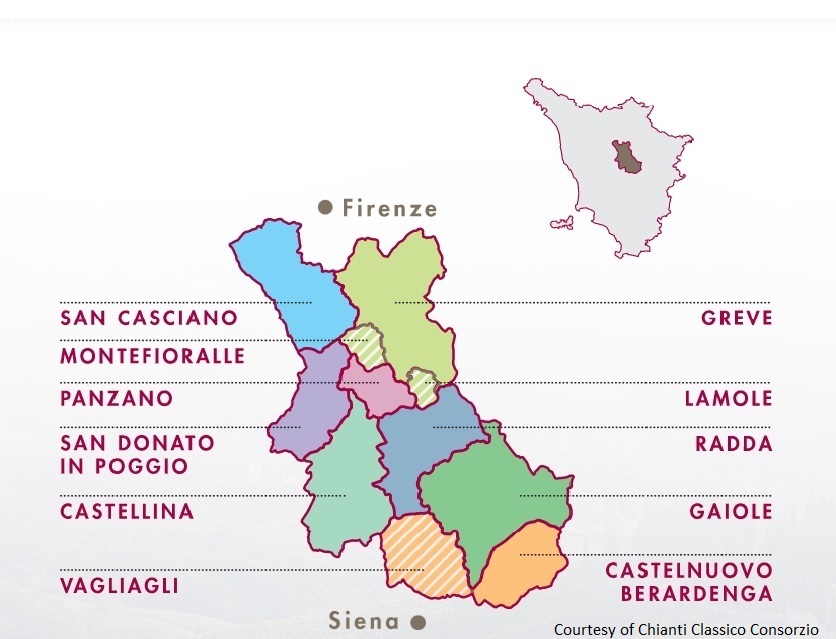
In 2021 the Chianti Classico Consorzio approved eleven subzones known as UGAs (Unità Geografiche Aggiuntive) within the appellation in an effort to be more specific with the terroir. Final approval is expected from the Ministry of Agriculture in Rome and the launch could take place with the 2020 vintage. For the moment, however, the subzone branding will be exclusive to Gran Selezione wines, the top of the Chianti Classico pyramid.
Note that Greve is the largest of the communes in Chianti Classico, and it’s broken into four UGAs: Greve, Lamole, Panzano and Montefioralle. The UGAs were established based on soil types, elevations, exposures–and the social network (the villages and historic centers of each zone). That is to say, the UGAs have attempted to incorporate the human dimension into the definition of terroir.
In 2022, Sofia was elected as president of the Vintners’ Association of Montefioralle to represent that UGA.
A final word: In May, 2023 Eric Asimov was interviewed about his experiences being the NY Times wine critic for the last 25 years. The last question posed to him was:
–What’s the one wine you wish more people knew about?
–I’ll just mention a very well-known wine, Chianti Classico. To my surprise, it continues to be consigned to the stereotype of Italian restaurant wine. It’s one of the great wines of the world.
The Wines
| Wine | Blend | Description |
|---|---|---|
| Chianti Classico Le Tre Vigne | Sangiovese | This is the estate's flagship, coming from three high elevation sites in the Greve Valley. The Terreno Vineyard on the eastern flank of the valley gives aromatics and beautiful fruit; Le Bonille, also on the eastern flank, lends structure and minerality; Sillano, very high on the western flank, contributes freshness and depth. Bear in mind that Greve is in the far northeast corner of the Chianti Classico. The northern part is cooler while the eastern side is hillier and therefore the northeastern corner is the coolest of all (Chianti from the western and southern communes can be weightier and more sun-soaked). The grapes are harvested by hand in small crates, and a second sorting is done at the cellar. Fermentations are spontaneous in steel, with subsequent élevage in large casks, primarily 24hl, for 14 months. No fining and bottled with a light filtration. ~3,000 cases. Tech sheet here. |
| Chianti Classico Le Bonille di Sopra Riserva | Sangiovese with roughly 10% Colorino and 5% Cabernet Sauvignon | This comes from Le Bonille high on the eastern flank of the Greve Valley. Alberese and other calcareous soils, with some galestro and clay. The grapes are harvested by hand in small crates, and a second sorting is done at the cellar. All lots and clones are micro-fermented spontaneously and separately in open-top fermenters. Elevage goes for two years in 24hl casks, followed by at least one year in bottle before release. No fining and bottled with a light filtration. ~650 cases. Tech sheet here. |
| Chianti Classico Sillano Gran Selezione | Sangiovese | High on the western flank of the Greve Valley, Sillano is the highest site in the Montefioralle UGA at 5oo meters. The bedrock is Pietraforte, a rare, stony calcareous soil. Soil and site make for dynamic aromas and an immense verticality in the wine, with fabulous length. The grapes are harvested by hand in small crates, and a second sorting is done at the cellar. All lots and clones are micro-fermented spontaneously and separately in open-top fermenters. Elevage goes for 18 months in 12hl and 24hl casks, followed by at least one year in bottle before release. No fining and bottled with a light filtration. ~350 cases. Tech sheet here. |
| Chianti Classico ASofia Gran Selezione | Sangiovese | ASofia is from the fruit of the estate's oldest vines, planted in the early 1980s, and made into a wine that sees the estate's longest élevage of 30 months in neutral 30hl casks. This comes from the Terreno Vineyard (south of Le Bonille), high on the eastern flank of the Greve Valley, rich in macigno and other non-calcareous marine sandstone soils. The specific parcel grows on a steep flank facing northwest. Soil, site, and old vines make for a wine of lovely nuance and florality. ASofia's structural profile is the horizontal counterpart to Sillano's verticality. The wine is only made in very good years. Its grapes are harvested by hand in small crates, and a second sorting is done at the cellar. All lots and clones are micro-fermented spontaneously and separately in open-top fermenters. The wine is aged in bottle before release for at least one year following élevage. No fining and bottled with a light filtration. ~350 cases. Tech sheet here. |